

7 Best Ways to Reduce Weekly Cleaning Time
Table of Contents
- Why Weekly Cleaning Eats Your Time (and What to Fix First)
- Daily Habits to Keep House Clean Without Extra Effort
- How to Declutter for Easier Cleaning
- Best Cleaning Tools for Efficiency: What Actually Cuts Time
- Zone Cleaning vs. Whole-House Cleaning: Which Wins
- Preventive Maintenance and Smart Home Integration
- How to Build a Cleaning Schedule That Sticks
- Frequently Asked Questions
Last Updated: September 17, 2026
Why Weekly Cleaning Eats Your Time (and What to Fix First)
Most households don't have a cleaning problem. They have a scheduling problem. The best ways to reduce weekly cleaning start with understanding that mess accumulates through small, repeated actions, not one big weekly event. The fix is rarely about working harder.
Daily Habits to Keep House Clean Without Extra Effort
Daily habits to keep house clean work because they prevent buildup rather than fight it. The trick is attaching new micro-tasks to things you already do, habit stacking. But it only works when you understand the loop underneath: cue, routine, reward. Skip the reward and the habit fades in about two weeks.
The Two-Minute Rule and Habit Stacking
The two-minute rule is simple: if a cleaning task takes under two minutes, do it immediately instead of adding it to a list. Wipe the bathroom counter after brushing your teeth. Rinse dishes as you cook. These small actions prevent the pileup that becomes a weekend project.
Nightly Reset Routines That Take Under 15 Minutes
A nightly reset is a short sequence that returns your main living spaces to a neutral state before bed. Fifteen minutes is enough for most homes:
- Load the dishwasher and start it
- Wipe down kitchen counters and the stovetop
- Fluff couch cushions and fold throw blankets
- Clear the coffee table and entryway surface
- Do one quick pass with a handheld vacuum on high-traffic areas
Why Cleaning Resistance Is a Brain Problem, Not a Discipline Problem
Most people who struggle with daily cleaning aren't lazy. Their brains are avoiding tasks that feel open-ended, ambiguous, and unrewarded. Three patterns drive most cleaning resistance, and each has a counter-move.
How to Recover When the Routine Breaks
Every routine breaks, travel, illness, a busy work week. The households that stay clean aren't the ones that never miss; they're the ones with a re-entry plan.
How to Declutter for Easier Cleaning
Learning how to declutter for easier cleaning is the highest-use change you can make. Every object on a surface is something to move, dust around, or clean under. Fewer objects means fewer minutes.
The 5-5-5 Rule and Minimalist Surfaces
The 5-5-5 rule keeps decluttering manageable: each session, find five items to throw away, five to donate, and five to return to their proper home. Fifteen items, ten minutes, done.
Best Cleaning Tools for Efficiency: What Actually Cuts Time
The best cleaning tools for efficiency aren't the most expensive ones. They're the ones that remove steps from a task. A tool that saves you thirty seconds per use, used daily, returns hours over a year.
| Tool | Time Saved Per Use | Best For | Price |
|---|---|---|---|
| 3-in-1 Robot Vacuum | 20-30 min | Daily floor maintenance | $49.99 |
| Hands-Free Flat Mop & Bucket Set | 5-10 min | Weekly floor washing | $37.99 |
| Magic Silicone Dishwashing Gloves | 3-5 min | Dish and surface scrubbing | $20.99 |
| Double Layer Sponge & Soap Rack | 2-3 min | One-hand dish cleaning | $14.99 |
Smart Gadgets That Automate the Boring Parts
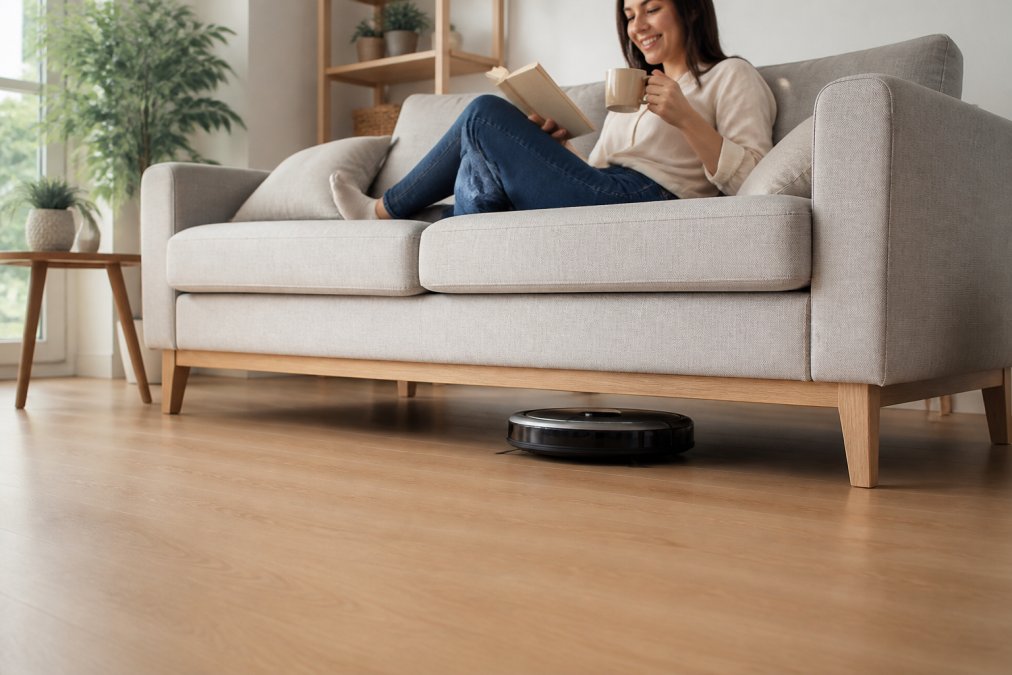
Automation handles the tasks you'd otherwise skip. Oatmehome's 3-in-1 Robot Vacuum runs up to 100 minutes on a charge with 1500Pa suction and Boost IQ technology. At just 2.85 inches tall, it cleans under low furniture where dust collects unnoticed. Auto-scheduling means it works while you're at work.

Zone Cleaning vs. Whole-House Cleaning: Which Wins
Zone cleaning beats whole-house cleaning for most households. Instead of cleaning everything at once, divide the home into zones and clean one per day: Monday the kitchen, Tuesday the bathrooms, Wednesday the floors, and so on.
| Approach | Time Per Session | Frequency | Best For |
|---|---|---|---|
| Zone cleaning | 15-25 min | Daily | Routine maintenance |
| Whole-house cleaning | 2-3 hours | Weekly | Pre-guest, post-event |
| Hybrid | 20 min + 1 hour | Daily + weekend | Busy families |
Preventive Maintenance and Smart Home Integration
Preventive maintenance stops mess before it starts. Most guides treat it as a list of tips. It's better understood as a system with four layers: barriers, surfaces, schedules, and sensors. Get all four working and the weekly clean shrinks on its own.
Layer 1: Barriers, Stop Dirt at the Door
Barriers are the cheapest preventive maintenance you can buy. A doormat at every entrance traps most tracked-in dirt before it hits your floors. A large share of indoor dust and tracked-in soil comes from outside, which is why entryway mats do more for floor cleanliness than any mop. Use a two-mat system: a coarse outdoor mat to scrape, a softer indoor mat to absorb.
Other barriers worth installing:
- Shoe-free entry. A bench and a shoe tray at the door cut the largest single source of tracked-in grit.
- A shower squeegee. Thirty seconds after each shower prevents soap scum from ever forming. Soap scum that never forms is soap scum you never scrub.
- Stove splatter guards. A $10 mesh screen catches grease before it hits the backsplash and hood.
- A boot tray in winter. Salt and slush stay in the tray instead of soaking into grout.
Layer 2: Surfaces, Choose Materials That Clean Themselves (Almost)
Surface choice is the most overlooked lever in home cleaning. The same room takes twice as long to clean depending on what it's made of.
- Matte and textured finishes hide dust but hold it. Gloss and semi-gloss wipe clean in one pass.
- Open shelving looks styled and collects dust on every object. Closed cabinets with doors take one wipe.
- Light-colored grout shows every spill. Sealed dark grout hides them.
- Wall-to-wall carpet traps allergens and needs deep cleaning. Hard flooring with a washable rug cleans in minutes.
- Glass shower doors show water spots instantly. A squeegee habit or a treated coating solves it.
Layer 3: Schedules, Automate the Recurring Tasks
A schedule is preventive maintenance for your attention. If a task happens on a fixed cadence, you stop having to decide when to do it. The decision is the expensive part.
A simple preventive schedule:
| Cadence | Task | Time |
|---|---|---|
| Weekly | Shake entry mats, rinse shower, wipe range hood filter | 10 min |
| Monthly | Vacuum refrigerator coils, descale coffee maker, wash pillow covers | 30 min |
| Quarterly | Clean dryer vent, wash windows, flip mattresses | 60 min |
| Annually | Deep clean carpets, service HVAC filter, wash curtains | 2-3 hours |
Layer 4: Sensors and Smart Home Integration, Let the House Tell You When
This is the layer most cleaning guides skip, and it's where the biggest time savings live. Smart home devices don't just clean, they remove the mental overhead of tracking when cleaning is due.
Smart sensors for air quality and humidity.
The Payoff
The point of preventive maintenance and smart home integration isn't luxury, it's removing the decision. When a task happens on its own, or tells you when it needs doing, it stops consuming mental energy. That freed-up attention is what actually reduces weekly cleaning, because you stop spending the week dreading the weekend.
How to Build a Cleaning Schedule That Sticks
A cleaning schedule that sticks is built around your actual week, not an ideal one. Track how long each task really takes for two weeks, most people overestimate cleaning time, which makes the whole job feel bigger than it is.
| Day | Task | Time |
|---|---|---|
| Monday | Kitchen zone + counters | 20 min |
| Tuesday | Bathrooms | 20 min |
| Wednesday | Floors (robot vacuum) | 5 min |
| Thursday | Bedrooms + dusting | 20 min |
| Friday | Living areas + entryway | 15 min |
| Saturday | One deep-clean task | 30 min |
| Sunday | Rest or catch-up | 0 min |
Frequently Asked Questions
What is the 5-5-5 rule for decluttering?
The 5-5-5 rule is a quick decluttering method: pick up five items to throw away, five to donate, and five to put back in their proper place. It takes about ten minutes and works well as a daily habit to keep house clean without a big time commitment. Doing it once a day prevents piles from forming on counters and floors, which makes your weekly clean much faster.
What are the most effective low-effort cleaning habits?
The highest-return habits are small and repeatable: wipe the bathroom sink after brushing, run a robot vacuum on a daily schedule, and clear the kitchen sink before bed. Habit stacking helps, like wiping counters while coffee brews. These bite-sized tasks take under five minutes each but stop mess from compounding, which is the main reason weekly cleaning takes so long.
How can I maintain a clean home without spending hours on chores?
Focus on prevention and automation. Use a preventive maintenance routine, keep surfaces minimal so dusting is quick, and let tools like a robot vacuum handle floors daily. A zone cleaning schedule spreads work across the week instead of one marathon session. Most people find that 15 to 20 minutes a day replaces a three-hour weekend clean.
What is the best way to organize a cleaning schedule for busy professionals?
Assign one zone per weekday, such as bathrooms on Monday and floors on Wednesday, and keep weekends free for deep cleaning only once a month. Pair each zone with a specific tool so you are not searching for supplies. A written schedule posted on the fridge keeps chore delegation clear if you share the home with others.
Weekly cleaning doesn't have to consume your weekend. The households that stay consistently tidy aren't cleaning more, they're cleaning smarter: small daily habits, decluttered surfaces, and tools that remove effort from every task. Oatmehome builds practical household solutions designed for exactly this, from a slim robot vacuum that handles floors on its own to a hands-free mop set that takes the strain out of washing. Get started with Oatmehome and take back your weekends.