

Essential Tools for New Apartment Moving: 2026 Guide
Table of Contents
- Your First Apartment Essentials List: What You Actually Need
- Essential Tools for New Apartment Moving: The Core Kit
- Best Tools for Furniture Assembly and Heavy Lifting
- Moving Day Survival Kit: What to Pack in Your First-Night Box
- How to Organize Tools in a Small Apartment
- Rental-Friendly Repair Techniques and Budget Tiers
- Conclusion: Build Your Kit One Move at a Time
- Frequently Asked Questions
Last Updated: September 20, 2026
Your First Apartment Essentials List: What You Actually Need
Building a first apartment essentials list starts with a simple truth: you need fewer tools than the internet tells you, but the right ones. This guide from Oatmehome covers the essential tools for new apartment moving that earn their place in a small closet, plus how to store them without losing floor space.
Essential Tools for New Apartment Moving: The Core Kit
The core kit for essential tools for new apartment moving fits in a single 12-inch toolbox and covers roughly nine out of ten tasks you'll face in your first year. Every tool below is chosen because it works inside a lease, not just inside a workshop.
Hand Tools Every Renter Should Own
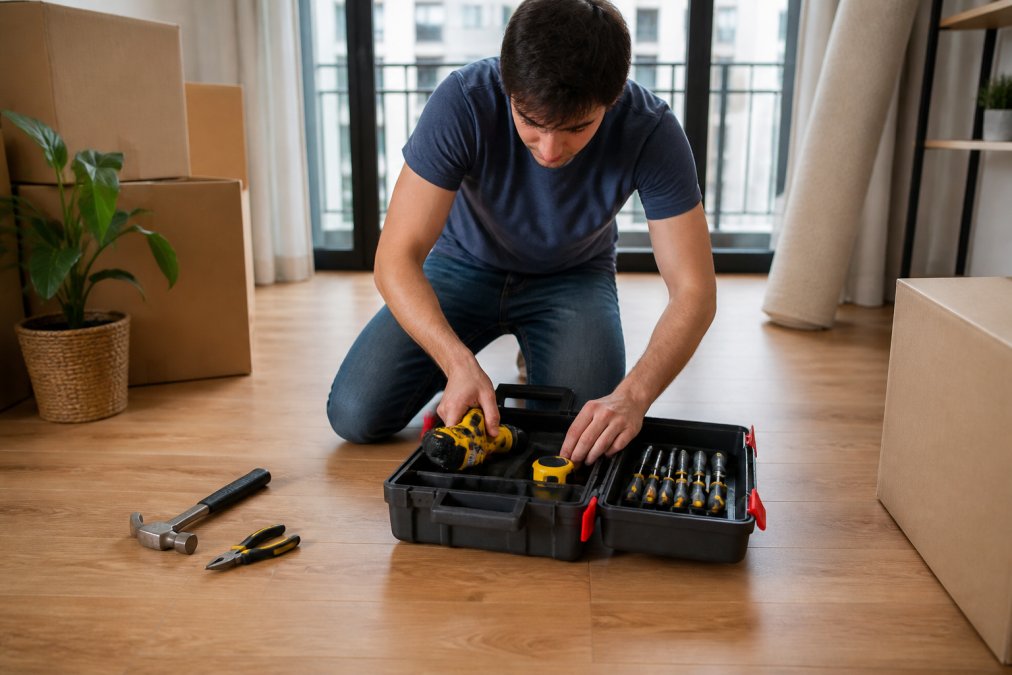
A claw hammer handles picture nails and furniture taps; look for a 16-ounce head. An adjustable wrench in the 8-inch size covers most plumbing nuts and showerhead swaps without a full wrench set. Add needle nose pliers, a 25-foot tape measure, a utility knife with retractable blade, and a multi-bit screwdriver with flathead and Phillips bits.
Power Tools vs. Manual Tools: What Makes Sense in an Apartment
A cordless power drill is the one power tool worth owning in an apartment. An 18-volt or 20-volt model with a 3/8-inch chuck drives furniture assembly screws in seconds and pairs with wall anchors for shelving. Everything else, from sawing to sanding, is a job for your building's maintenance team or a rental counter, and many leases ban running a circular saw on a balcony or hallway anyway.
| Tool Type | Best For | Storage Footprint | Renter Verdict |
|---|---|---|---|
| Cordless drill (18V-20V) | Furniture, anchors, shelves | Small case | Buy it |
| Manual screwdriver | Light assembly, outlets | Drawer | Buy it |
| Circular saw | Cutting lumber | Large | Skip it |
| Stud finder | Hanging heavy items | Drawer | Buy it |
| Oscillating multi-tool | Trim, tight cuts | Medium case | Nice-to-have |
Rental-Friendly Tool Choices That Protect Your Deposit
Every tool in your kit should be evaluated against one question: does using it leave a mark a landlord will charge you for?
- Damage-free hanging: A picture hanging kit with adhesive strips and small finishing nails covers most decor. Reserve drilled anchors for items over 20 pounds, and patch the holes before move-out.
- Tension-mounted instead of drilled: Tension rods for curtains and shower caddies avoid drilling entirely. Suction mounts work for light bathroom items but fail on textured walls.
- Furniture that doesn't scratch: Felt pads under every leg cost a few dollars and prevent the floor scratches that eat into a security deposit.
- No plumbing disassembly: An adjustable wrench can tighten a loose faucet handle, but anything beyond that is a maintenance call, most leases prohibit tenant plumbing work, and a leak you cause is on you.
Best Tools for Furniture Assembly and Heavy Lifting
Furniture assembly is where most renters underestimate the job. Flat-pack furniture arrives with Allen wrenches the size of a toothpick and instructions that assume two people and three free hours.
Measuring, Leveling, and Fastening Essentials
A stud finder, a level, and a tape measure keep shelves straight and anchors in solid wood. For drywall, keep wall anchors in two sizes and a picture hanging kit with assorted hooks.
Moving Day Survival Kit: What to Pack in Your First-Night Box
Your moving day survival kit is the one box you keep with you, not on the truck. Pack it the night before and label it clearly.
- Toilet paper and hand soap
- Phone charger and a power strip
- Scissors and a utility knife for opening boxes
- Basic toolkit with screwdriver, hammer, and tape measure
- Snacks, water, and a portable kettle for coffee or tea
- Bedding and a change of clothes
- Trash bags and paper towels
- Medications and a small first-aid kit
How to Organize Tools in a Small Apartment
Organizing tools in a small apartment comes down to vertical space and one rule: everything gets a home, or it gets donated. A toolkit that lives in a designated spot gets used; a pile of loose tools in a junk drawer gets forgotten. With no wall to spare, no bench, and no shed, storage and maintenance have to be designed together.

Compact Storage Solutions That Save Square Footage
A compact storage setup works best when it uses space you already have. Here's how the common options compare on actual square footage consumed:
| Storage Solution | Best For | Space Used | Typical Capacity |
|---|---|---|---|
| Under-bed bin (low-profile, ~6 in tall) | Long tools, level, tape | Floor gap under bed | 1-2 toolboxes |
| Over-door organizer | Screwdrivers, pliers, small parts | Door back (zero floor) | 12-24 pockets |
| Rolling cart (~12 in wide) | Cleaning supplies, caddies | Closet corner | 3 tiers |
| Wall hooks or a pegboard strip | Mop, broom, dustpan | Vertical wall, ~18 in wide | 4-6 hanging items |
| Tool roll (canvas) | Wrenches, hex keys, bits | Drawer or hook | 10-15 tools |
Tool Maintenance in a Space With No Workshop
Tools that live in a humid bathroom closet or a dusty under-bed bin degrade faster than tools in a garage, and renters rarely think about it until a screwdriver slips or a drill bit rusts.
- Wipe metal before storage. A quick pass with a dry cloth after each use removes the dust and moisture that cause rust. A light coat of general-purpose oil on wrench jaws and drill chucks once or twice a year is enough.
- Keep batteries out of extreme temperatures. Cordless drill batteries lose capacity if stored in a hot car or a freezing balcony closet. Room temperature, roughly 60-80°F, is the safe range.
- Check the drill chuck and bits. A chuck that won't tighten evenly strips screw heads. If bits wobble, replace them, a set of common sizes costs less than the furniture you'll damage.
- Don't store tools in the bathroom. Humidity is the enemy of steel. If your only closet is the bathroom linen closet, add a small moisture-absorbing packet to the bin.
- Do a seasonal five-minute audit. Tighten the hammer head if it's loose, test the stud finder battery, and confirm your anchor supply hasn't run out before you need it.
Rental-Friendly Repair Techniques and Budget Tiers
Rental-friendly repairs share one principle: leave no trace. Command strips instead of nails, tension rods instead of drilled brackets, suction mounts instead of screws, these protect your security deposit and still solve the problem.
Conclusion: Build Your Kit One Move at a Time
Every move teaches you which tools you actually reach for. Start with the core kit, add a power drill when furniture assembly becomes routine, and upgrade storage as your space demands it.
Frequently Asked Questions
What basic tools do I need for a new apartment?
Start with a cordless drill, adjustable wrench, claw hammer, tape measure, screwdriver set with flathead and Phillips head bits, utility knife, and a level. Add needle nose pliers, an Allen wrench set, and a stud finder for wall hanging. A 48-in-1 universal socket wrench like Oatmehome's ($21.99) replaces a bulky socket set and fits standard and metric bolts. This core kit handles furniture assembly, picture hanging, and most DIY repairs without overflowing a small closet.
Do I need a power drill for apartment furniture assembly?
A cordless power drill speeds up furniture assembly significantly, especially for flat-pack pieces with dozens of screws. It also helps with wall anchors and curtain rods. For light tasks, a multi-bit screwdriver works fine. If you buy one power tool, make it a compact cordless drill with a few drill bits and driver heads. Renters should keep a manual screwdriver on hand for delicate hardware that a drill could strip.
How do I organize my tools for a small apartment?
Use a compact toolbox or a wall-mounted pegboard inside a closet door. Group tools by task: assembly, hanging, and cleaning. Store drill bits and fasteners in small clear containers so you can see them without digging. Vertical storage, under-bed bins, and over-the-door organizers keep tools out of living space. A rolling cart or a slim storage tower fits in a corner and keeps essentials accessible without sacrificing square footage.
What should I pack in my first-night box for a new apartment?
Pack a moving day survival kit with toilet paper, hand soap, a towel, a phone charger, a change of clothes, snacks, water, and any medications. Include basic tools like a screwdriver, utility knife, and tape measure so you can assemble a bed or hang a shower curtain before the boxes are unpacked. Add a portable kettle like Oatmehome's foldable silicone model ($33.99) for coffee or tea without hunting for the kitchen box.
What are the most overlooked tools when moving into an apartment?
People forget a stud finder for hanging shelves and TVs, a level for aligning pictures, and furniture sliders for moving heavy pieces without scratching floors. A furniture moving tool kit ($43.99) with a lifter and swivel wheels lets one person slide a sofa or bed. Also overlooked: duct tape, electrical tape, super glue, and a plunger. These small items prevent last-minute store runs during the first week.
How can I make moving into a new apartment easier?
Label boxes by room and pack a separate first-night box with essentials. Measure doorways and hallways before moving day to confirm furniture fits. Use furniture sliders or a moving tool kit to protect floors and your back. Assemble furniture gradually, starting with the bed and a seating area. Keep a basic toolkit accessible so you can tighten legs, hang curtains, and install shelves without searching through packed boxes.