

How to Choose Long Lasting Cookware: 2026 Guide
Table of Contents
- Start With Materials: The Foundation of Long Lasting Cookware
- Most Durable Cookware Materials and How They Compare
- Construction Details That Separate Quality From Disposable
- How to Care for Stainless Steel Pans So They Last Decades
- Signs of Worn Out Cookware: When to Repair and When to Replace
- Stovetop Compatibility, Weight, and Ergonomics for Real Kitchens
- Budget vs. Investment: What You Actually Get for the Money
- Frequently Asked Questions
Last Updated: September 12, 2026
Start With Materials: The Foundation of Long Lasting Cookware
Choosing long lasting cookware starts with understanding what a pan is actually made of, because the material determines how it heats, how it wears, and whether it can be repaired. According to the U.S. Department of Energy's appliance and kitchen guidance, the way a pan conducts and holds heat affects both energy use and cooking results. This guide shows you how to evaluate a pan before you buy it, so the next set you own stays in service for years.
The biggest mistake is treating all metal pans as interchangeable. They are not.
Cladding is the process of bonding layers of different metals together, usually stainless steel over an aluminum or copper core, so the pan gets even heating without a reactive cooking surface. Gauge refers to the thickness of that metal: heavier gauge resists warping, lighter gauge dents and bows under high heat.
Cladding, Gauge, and What They Mean for Durability
A clad pan with a thick aluminum core spreads heat across the whole base instead of concentrating it in a hot ring above the burner. Thin, single-layer pans heat unevenly and warp when they hit cold water while hot. When you shop, look for a visible layered edge on the rim, and pick up the pan: weight is a rough proxy for gauge, and a flimsy-feeling pan usually is.
Reactivity: Why Some Metals React to Acidic Foods
Reactive surfaces, bare aluminum, copper, and cast iron, can discolor or take on a metallic taste when you cook acidic foods like tomato sauce or vinegar for a long time. Stainless steel and enameled surfaces are non-reactive, making them safer for long simmers. Carbon steel and cast iron sit in between: reactive, but their seasoning layer protects the surface once it builds up.
Most Durable Cookware Materials and How They Compare
The most durable cookware materials are stainless steel, cast iron, and carbon steel, with nonstick trailing because the coating, not the metal, is the weak point. Clad stainless steel offers the best balance of durability, low maintenance, and versatility for most kitchens. But "durable" is not one property, it is how a material resists warping, corrosion, scratching, and thermal shock, and how easily it can be brought back once it fails.
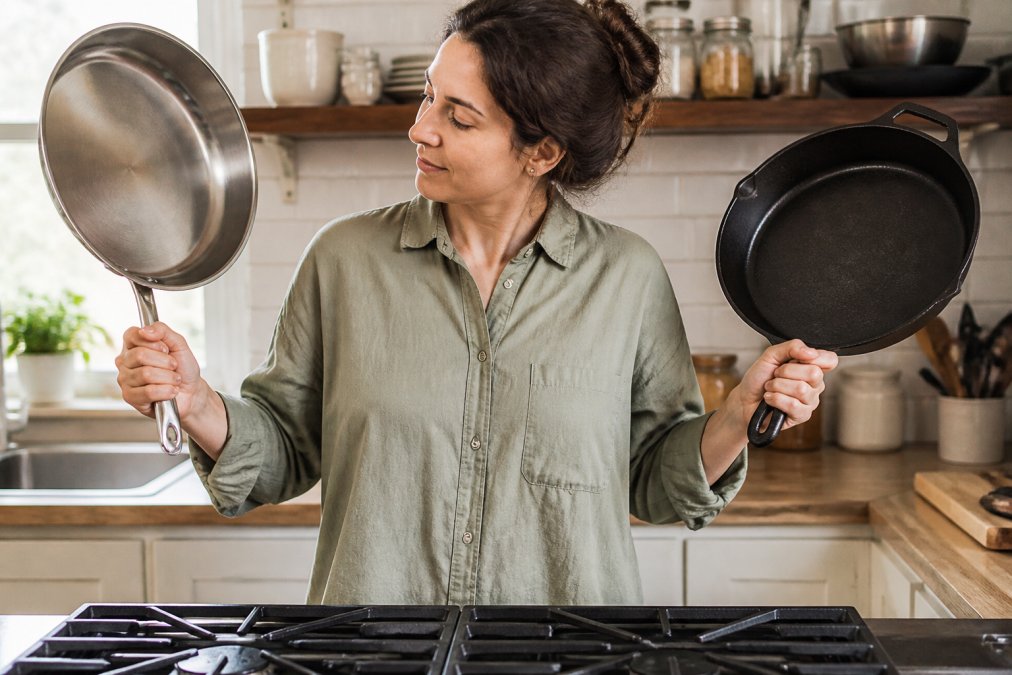
Stainless Steel vs. Cast Iron vs. Carbon Steel vs. Nonstick
| Material | Durability | Heat Behavior | Maintenance | Repairable? | Realistic Lifespan | Best For |
|---|---|---|---|---|---|---|
| Stainless steel (clad) | Very high | Even, responsive | Easy, dishwasher-friendly | Yes, polish scratches, re-tighten handles | 20+ years with care | Everyday cooking, acidic sauces |
| Cast iron | Very high | Slow, retains heat | Seasoning required | Yes, strip rust and re-season | Generations if kept dry | Searing, braising, baking |
| Carbon steel | High | Fast, responsive | Seasoning required | Yes, same as cast iron | 10-20 years | High-heat searing, stir-frying |
| Nonstick | Limited | Even but delicate | Gentle hand washing | No, coating cannot be restored | 1-5 years | Eggs, low-fat cooking |
| Enameled cast iron | High (unless chipped) | Slow, retains heat | Easy, no seasoning | Partially, chips expose bare iron | 10-20 years | Braising, acidic stews |
Repairability is what changes the math. Cast iron and carbon steel are effectively immortal because rust and lost seasoning are surface problems, steel wool, oil, and heat bring them back. Clad stainless survives scratches and discoloration because the cooking surface is solid metal all the way through; a scuff is cosmetic, not functional. Nonstick is the outlier: once the coating flakes or scratches through to the substrate, there is no restoration path.
Heat Conductivity, Distribution, and Warp Resistance
Thermal conductivity decides how quickly a pan responds to burner changes; heat distribution decides whether the whole surface cooks evenly. Copper conducts best, aluminum is close behind, and stainless steel conducts poorly alone, which is why it is clad over an aluminum or copper core. Warp resistance comes down to gauge and core thickness: a heavy, fully clad pan holds its flat base far longer than a stamped thin one.
The failure mode to watch for is differential expansion: when a thin pan hits high heat, the cooking surface and base expand at different rates and the base bows. A heavy clad pan distributes that stress across a thicker cross-section, so the base stays flat. That is why a 3-ply or 5-ply pan with a visible layered rim outlasts a disk-bottom pan, whose bonded layers can delaminate after repeated thermal shock.
Material-Specific Failure Points
Each material fails in a predictable way, and knowing the signature helps you catch problems before they end a pan's life:
- Clad stainless: pitting from prolonged salt or acid contact, and loosening rivets. Both are slow and largely preventable.
- Cast iron: rust from moisture left on the surface, and cracked sidewalls from dropping a hot pan into cold water.
- Carbon steel: the same rust and seasoning loss as cast iron, plus warping if the steel is thin.
- Nonstick: coating flaking, scratching to bare metal, and loss of release, all terminal.
- Enameled cast iron: chipping at the rim or interior, which exposes bare iron and cannot be repaired.
Construction Details That Separate Quality From Disposable
Construction details decide whether a pan survives a decade of daily use or fails in a year. Three features matter most: handle attachment, base thickness, and whether the rim is rolled or sealed.
Riveted handles, where metal fasteners pass through the pan wall, hold up far better than screwed-on or welded handles that work loose. A fully clad base that runs up the sides heats more evenly than a disk-bottom pan, which can delaminate after repeated thermal shock. Rolled or sealed rims keep moisture out of the core, preventing internal corrosion and pitting.
How to Care for Stainless Steel Pans So They Last Decades
Stainless steel pans last decades when you preheat gently, cook on medium heat, and clean without abrasive scrubbing. The metal is tough; most damage comes from how it is treated.
- Preheat on medium, not high, and add oil before food.
- Let the pan cool before running it under water to avoid thermal shock.
- Use metal utensils freely on uncoated stainless; save soft tools for nonstick.
- For stuck-on food, deglaze with warm water while the pan is still warm, then wash.
- Dishwashing is fine for most clad stainless, but hand-drying prevents water spots.
Stainless steel's corrosion resistance comes from chromium, which forms a passive layer that resists rust. That layer can still be damaged by prolonged contact with salt or acidic foods left sitting in the pan, so rinse soon after cooking. That small habit separates a pan that lasts five years from one that lasts twenty.
Signs of Worn Out Cookware: When to Repair and When to Replace
Most worn cookware can be repaired rather than replaced, and knowing which is which saves real money. Cast iron and carbon steel are the most repairable: rust and lost seasoning come back with steel wool, oil, and a re-seasoning session. Stainless steel responds well to polishing out scratches and discoloration.
Nonstick is the exception: once the coating flakes, scratches through to the metal, or loses its release, it cannot be restored. Watch for these failure signals:
- Warping: a rocking pan no longer sits flat, so heat pools in one spot.
- Pitting: small corrosion craters in the surface, common on reactive metals.
- Delamination: the clad layers separating, usually visible at the rim.
- Loose handles: often fixable by tightening or replacing the fastener.
Stovetop Compatibility, Weight, and Ergonomics for Real Kitchens
Stovetop compatibility and ergonomics decide whether a durable pan actually gets used. Two pans of equal quality can live very different lives depending on whether they sit flat on your burner and whether you can lift them comfortably. Most guides stop at "check for induction compatibility"; the better question is how that compatibility holds up over the pan's life, and whether its weight will still suit you in ten years.
Induction Compatibility and Magnetic Base Integrity
Induction burners do not heat the pan, they induce a current in a ferromagnetic base, which then heats the food (energy.gov). The pan must be magnetic to work at all. Test any candidate with a fridge magnet before buying: if it does not stick firmly to the base, it will not heat on an induction cooktop. Cast iron and most magnetic stainless steel pass; pure aluminum and copper do not unless they carry a bonded magnetic base plate.
The long-term issue is base integrity. On a clad pan, the magnetic layer is part of the bonded stack, and if that stack delaminates, usually from thermal shock or a warped base, the pan can lose even heating or stop triggering the burner. A disk-bottom pan with a magnetic plate is more vulnerable because the plate is a separate bond that can fail. When inspecting a used pan, set it on a flat surface and check for rocking; a warped base on induction produces a hot spot and can trip the burner's safety cutoff.
Gas and electric coil are far less fussy about base material, but they still punish a warped pan: on gas, a bowed base lets flame escape up the sides; on coil, it leaves the pan resting on the element's high points.
Weight and Ergonomics for Aging Cooks
Weight matters more than most guides admit, and it is the biggest reason a durable pan gets abandoned. A heavy cast iron skillet is wonderful for searing and miserable for someone with arthritis, a weak grip, or wrist strain. The trade-off is real: the mass that gives cast iron its heat retention makes it hard to lift one-handed, especially when full.
A practical way to think about it is by pan size. A 10-inch cast iron skillet typically weighs around 5 pounds empty; a comparable clad stainless skillet often runs 2 to 3 pounds; carbon steel sits in between and lightens as it seasons (americastestkitchen.com). For limited grip strength, a lighter clad stainless or carbon steel pan delivers most of the durability with far less heft, and a helper handle on larger sizes spreads the load across two hands.
Handle design is part of ergonomics too. Look for a handle that stays cool on the stovetop, is oven-safe if you finish dishes in the oven, and fits your grip rather than a thin, slick tube. A comfortable pan gets used; an uncomfortable one sits in the cabinet no matter how well it is built.
Budget vs. Investment: What You Actually Get for the Money
Spending more on cookware buys thicker cladding, better handles, and a longer service life, not just a brand name. The value question is not "cheap versus expensive" but "how many years of use per dollar."
A thin, inexpensive pan may need replacing every couple of years, while a well-built clad stainless or cast iron pan can last a decade or more with basic care. That math favors buying fewer, better pieces over a large set of flimsy ones. A practical starter approach:
- One clad stainless skillet for everyday and acidic cooking
- One cast iron or carbon steel pan for searing and high heat
- One nonstick pan, replaced as needed, for eggs and delicate foods
Buying open-stock pieces instead of a matched set lets you invest where it counts and skip pans you will never use. Oatmehome offers a curated range of kitchen essentials designed to simplify daily routines, focusing on functionality and reliable design.
Frequently Asked Questions
What type of cookware lasts the longest?
Stainless steel and cast iron consistently outlast other options. Stainless steel with a copper or aluminum core resists corrosion, pitting, and warping for decades when cared for properly. Cast iron can last generations if you maintain its seasoning and prevent rust. Carbon steel sits between the two, offering similar longevity with lighter weight. Nonstick coatings have the shortest lifespan because the coating degrades with heat and metal utensils, typically needing replacement within a few years.
How can you tell if a cookware set is high quality?
Check the weight and thickness first. Heavy-gauge construction with a thick base resists warping better than thin pans. Look for riveted handles, which stay tight longer than screwed-on ones. Check whether the pan is oven-safe and induction compatible, since these features signal better engineering. Run your hand along the rim to feel for sharp edges or uneven cladding, which suggest lower manufacturing standards.
What are the signs of worn out cookware?
Watch for pitting, flaking, or bubbling on the cooking surface, which means the coating or cladding is failing. Warped bottoms that spin on a flat surface no longer distribute heat evenly. Deep scratches that expose the base metal under a nonstick coating make the pan unsafe to use. Loose or cracked handles are a structural failure. Rust that returns after cleaning, or persistent sticking on stainless steel that was previously nonstick, also signal it is time to replace.
How does proper maintenance extend the life of your cookware?
Let pans cool before washing to avoid thermal shock, which can warp metal and crack coatings. Use medium heat instead of high heat for most cooking, since overheating breaks down nonstick coatings and discolors stainless steel. Wash stainless steel pans by hand with warm soapy water and dry immediately to prevent water spots and pitting. Season cast iron and carbon steel after each use with a thin layer of oil. Store pans with protectors between them to avoid scratches.
Replacing cookware every couple of years gets expensive and frustrating, and the fix is buying pieces built to last and caring for them properly. Oatmehome curates kitchen essentials with a focus on reliable functionality and everyday design, so the tools you cook with hold up to daily use. Browse the Oatmehome kitchen range to find durable pieces that simplify cooking and organizing, and build a set that stays with you. Shop Now.