

How to Organize Small Kitchen Cabinets: 2026 Guide
Table of Contents
- What You'll Need Before You Organize Small Kitchen Cabinets
- How to Declutter Kitchen Cabinets Before Organizing
- Vertical Storage Solutions for Kitchen Cabinets
- Best Kitchen Cabinet Organizers for Small Spaces
- Zone-Based Layout: Organize Small Kitchen Cabinets by Use
- Ergonomic Accessibility and Aging-in-Place Considerations
- Common Mistakes to Avoid When Organizing Kitchen Cabinets
- Maintenance Schedule to Keep Cabinets Organized Long-Term
What You'll Need Before You Organize Small Kitchen Cabinets
Learning how to organize small kitchen cabinets is one of the highest-return projects you can tackle in a weekend. At Oatmehome, we offer practical solutions designed to simplify daily routines, and the difference is always in the preparation.
Before you pull out a single shelf liner or drawer insert, gather these essentials:
- A tape measure (cabinet depth and height matter more than most people realize)
- Cleaning supplies: an all-purpose spray and a microfiber cloth
- Masking tape and a marker for labeling categories
- A few cardboard boxes or bins for sorting
- A notepad for your inventory list
Cabinet depth is the measurement most guides skip entirely. Standard upper cabinets run 12 inches deep; base cabinets typically run 24 inches. Knowing your exact dimensions before you shop for organizers prevents the frustrating experience of buying shelf risers that are too tall or drawer inserts that don't fit. Measure twice, buy once.
Also check your cabinet hardware. Loose hinges or broken shelf pegs make organizing nearly impossible, fix those first. A five-minute repair saves hours of frustration later.
How to Declutter Kitchen Cabinets Before Organizing
Decluttering is where the real work happens. Most people skip straight to buying organizers, then wonder why nothing sticks. The truth: you cannot organize clutter. You can only move it around.
The Four-Category Sort Method
Pull everything out of your cabinets and sort each item into one of four categories:
- Keep, Used at least once in the past three months
- Relocate, Belongs in a different room or cabinet zone
- Donate, Functional but genuinely not used
- Discard, Broken, expired, or duplicated beyond reason
Work one cabinet at a time. Trying to empty every cabinet simultaneously creates chaos that discourages follow-through. The four-category method forces honest decisions: if you haven't used a gadget in three months, you probably won't. According to NAPO (National Association of Productivity and Organizing Professionals), the most effective decluttering sessions happen in short, focused bursts rather than marathon clear-outs. Start with 20 minutes per cabinet.
A common mistake is keeping duplicates "just in case." Three spatulas are two too many. Pare down to one excellent version of each tool.
Setting Up a Simple Inventory System
Once you've decluttered, create a basic inventory before anything goes back in. This is a crucial step for long-term maintenance.
Write down every category of item you're keeping: bakeware, spices, canned goods, small appliances, cookware. Assign each category a cabinet zone before you start loading items back in. A handwritten list taped inside a cabinet door works perfectly. Digital notes apps work too, the format matters less than the act of recording.
This inventory becomes your reference point when you shop for organizers, and it helps prevent the slow drift back to chaos that can defeat organizing efforts.
Vertical Storage Solutions for Kitchen Cabinets
Vertical space is the most underused dimension in small kitchens. Most cabinets are 12 to 30 inches tall, but items stacked flat use only a fraction of that height. The fix is simple: add layers.
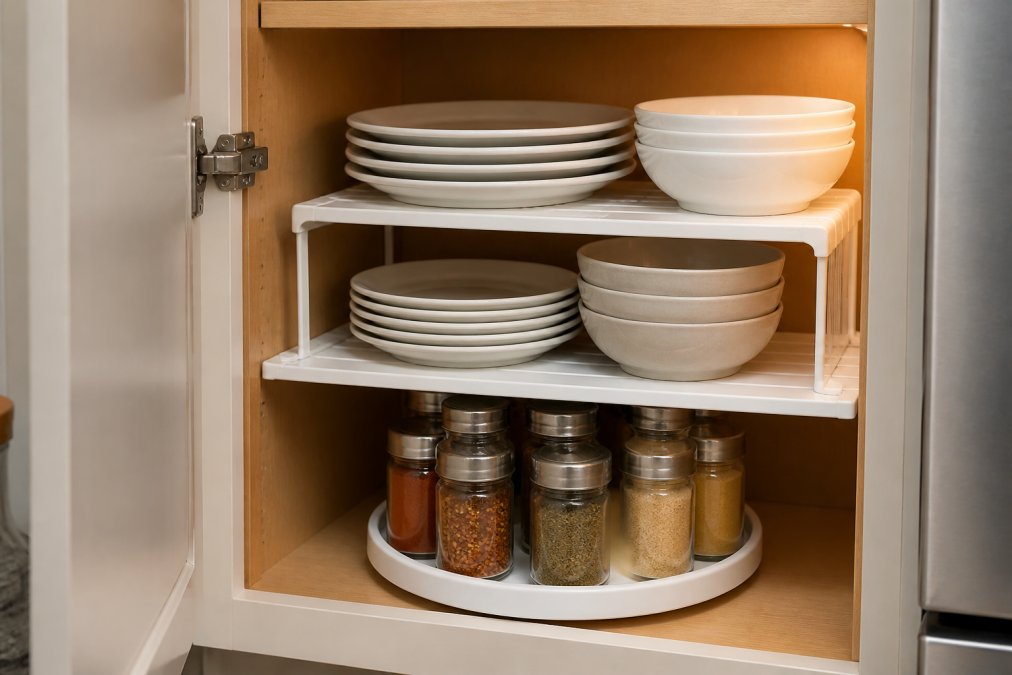
Shelf Risers and Stackable Bins
Shelf risers are a highly effective tool for doubling cabinet capacity without spending much. Place a riser on a cabinet shelf and you immediately create two usable tiers from one. Stack plates on the lower level, bowls or mugs on the raised tier above.
Stackable bins take the same principle further. Clear stackable bins let you see contents at a glance, critical in a small kitchen where hunting for ingredients costs real time. Use them for:
- Canned goods (stack two high, labels facing forward)
- Snack packets and pouches
- Baking supplies like chocolate chips, nuts, and dried fruit
- Small appliance accessories
The American Institute of Architects' kitchen design guidelines recommend that frequently used items stay within the 18-to-54-inch ergonomic reach zone. Shelf risers help you place items at accessible heights rather than buried behind taller stacks.
Cabinet Door Storage with Tension Rods and Adhesive Hooks
Cabinet doors are prime real estate most kitchens waste entirely. Two tools unlock this space without drilling: tension rods and adhesive hooks.
Tension rods installed vertically inside a cabinet create dividers for baking sheets, cutting boards, and pan lids. Instead of stacking flat (where the item you need is always on the bottom), everything stands upright and slides out individually. This is a practical renter-friendly hack because it requires zero wall damage.
Adhesive hooks on cabinet doors hold measuring cups, pot lids, or small utensil organizers. Choose hooks rated for the weight you're hanging, most adhesive hooks specify a maximum load on the packaging. For heavier items, over-the-door organizers with hooks that rest on the cabinet frame require no adhesive at all.
Best Kitchen Cabinet Organizers for Small Spaces
The best kitchen cabinet organizers solve a specific problem rather than attempting to do everything. Buying generic organizing kits often means half the pieces don't suit your actual cabinets. Match the tool to the problem.
Drawer Inserts and Dividers
Drawers are where kitchen organization most often collapses. Without structure, utensils migrate into a tangled pile within days of organizing.
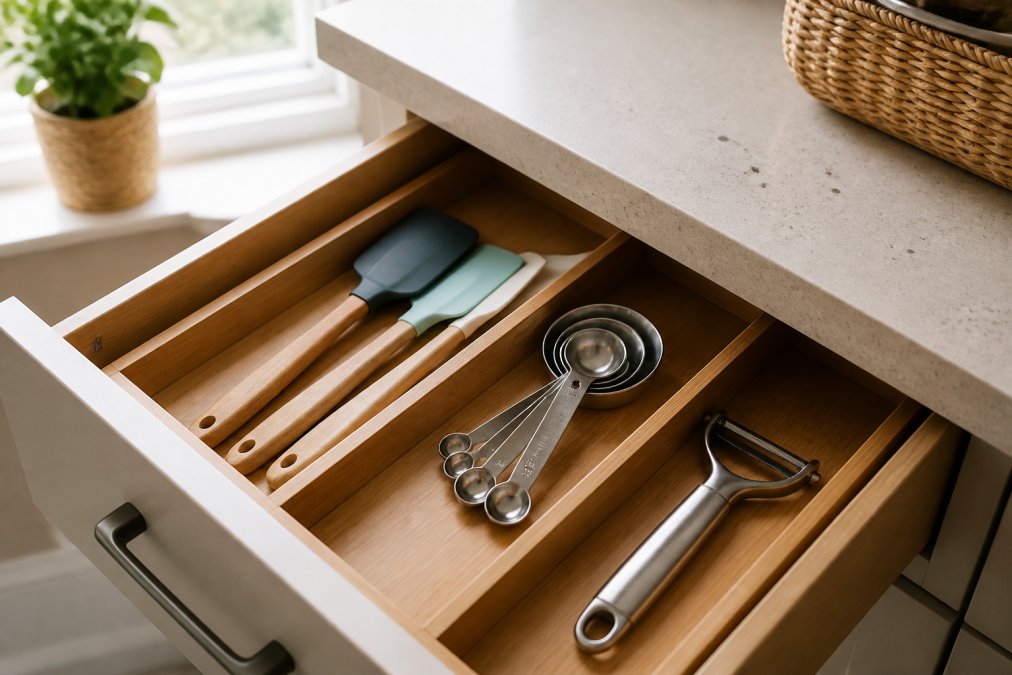
Drawer inserts and dividers create fixed zones for each tool category. Bamboo dividers are adjustable and suit most standard drawer widths. Plastic interlocking inserts work well for cutlery and small tools. For deep drawers, two-tier drawer organizers stack items vertically, effectively doubling the drawer's capacity.
The most important principle: group by function, not by type. Keep your most-used prep tools (peeler, can opener, spatula) in the drawer closest to your main prep surface. Rarely used tools go in the back of a deeper drawer or a less accessible cabinet.
Lazy Susans and Turntables
A lazy Susan is an underrated organizer in a small kitchen. Place one in a corner cabinet or a deep base cabinet and suddenly every item at the back becomes accessible with a single spin.
Turntables work equally well inside upper cabinets for spices and oils. Instead of moving six bottles to reach the one at the back, you rotate the turntable. This small change can eliminate one of the most common kitchen frustrations: the invisible back-of-cabinet graveyard where ingredients get forgotten and expire.
Two-tier lazy Susans double the storage capacity in a single cabinet footprint. Use the lower tier for heavier items (oils, vinegar, canned goods) and the upper tier for lighter items (spice jars, small packets).
Under-Sink Storage and Modular Shelving
Under-sink cabinets are notoriously difficult because of the plumbing that runs through them. Most people treat this space as a dumping ground. It doesn't have to be.
Modular shelving units designed for under-sink use work around pipes with adjustable configurations. Stackable bins on one side, a small tension rod across the back for hanging spray bottles, and a tiered shelf on the other side can create a functional storage system in a space most kitchens waste.
For cleaning supplies, group everything by task: surface cleaners together, dish supplies together, trash bags together. This zone-based approach means you grab what you need without searching.
Zone-Based Layout: Organize Small Kitchen Cabinets by Use
Zone-based storage is an organizing framework that can help create functional kitchens. The principle: store items where you use them, not where they fit.
Divide your kitchen into four zones:
| Zone | Location | What Belongs Here |
|---|---|---|
| Prep Zone | Near cutting board/main counter | Knives, peeler, cutting boards, mixing bowls |
| Cook Zone | Near stove/oven | Pots, pans, spatulas, tongs, pot holders |
| Serve Zone | Near dining area or plates | Plates, glasses, serving bowls, napkins |
| Store Zone | Pantry or deep cabinets | Dry goods, canned foods, baking supplies |
Group items by frequency of use within each zone. Daily-use items go at eye level and within easy reach. Weekly-use items go on upper shelves or in back sections. Rarely used items (holiday bakeware, specialty tools) go in the highest or most awkward cabinets.
This approach reduces the number of steps between grabbing an ingredient and using it. In a small kitchen, that efficiency compounds: a well-zoned kitchen can feel larger because movement through it is more direct.
Ergonomic Accessibility and Aging-in-Place Considerations
Ergonomic accessibility is an important consideration for long-term usability. The U.S. Access Board's residential kitchen accessibility guidelines recommend keeping frequently accessed items between 15 and 48 inches from the floor for users with limited reach or mobility.
For aging-in-place households, a few specific adjustments make a significant difference:
- Pull-out shelves installed in base cabinets can eliminate the need to crouch and reach to the back. These can be retrofitted into most existing cabinets with basic tools.
- D-ring or loop cabinet hardware is easier to grip than small knobs for people with reduced hand strength or arthritis.
- Contrasting bin colors can help users with low vision identify zones quickly without reading labels.
- Avoid stacking heavy items above shoulder height. Cast iron cookware stored in upper cabinets is a fall and injury risk.
These modifications don't require professional installation or custom cabinetry. Most are DIY-friendly and renter-compatible. The investment can pay off for everyone in the household, not only those with mobility considerations.
Common Mistakes to Avoid When Organizing Kitchen Cabinets
Most people who organize small kitchen cabinets run into the same handful of problems. Knowing them in advance saves a full re-do.
Buying organizers before decluttering. This is a common mistake. Organizers purchased before you know exactly what you're keeping often don't fit the final inventory. Declutter first, measure second, buy third.
Ignoring cabinet depth. Items stored more than 12 inches deep in upper cabinets are effectively invisible. Use pull-out bins or turntables to bring deep-cabinet items forward.
Organizing by item type instead of frequency. Grouping all bakeware together sounds logical until you realize your daily coffee supplies are behind your once-a-year bundt pan. Frequency of use should always override category logic.
Over-organizing. A system with too many sub-categories can collapse quickly because it demands too much maintenance. Aim for broad, intuitive zones rather than hyper-specific slots for every item.
Skipping labels. Labels feel unnecessary when you set a system up, you know where everything is. Three months later, after a busy week, the system starts drifting. Labels are a low-effort maintenance tool that prevents drift.
Maintenance Schedule to Keep Cabinets Organized Long-Term
Organization without maintenance is just delayed clutter. The goal is a system simple enough that upkeep takes minutes, not hours.
Follow this schedule:
Weekly (5 minutes): Wipe down cabinet shelves touched most often. Return any items that migrated out of their zones. Check that the under-sink area hasn't accumulated stray bottles.
Monthly (15 minutes): Do a quick inventory check. Are spices or pantry items approaching expiration? Rotate stock so older items move to the front. Wipe down lazy Susans and turntables.
Quarterly (30 minutes): Full cabinet audit. Pull everything out of one or two cabinets, wipe shelves, reassess whether the zone layout still matches how you actually cook. Kitchens evolve, your organization system should too.
Annually: Repeat the full four-category sort. Donate gadgets you haven't used. Reassess whether your current organizers still suit your needs, or whether a different configuration would serve you better.
As documented in Cornell University's research on household organization and behavior change, systems that include scheduled maintenance routines are significantly more likely to be sustained long-term than those set up without one. The schedule doesn't need to be rigid, it just needs to exist.
The Oatmehome range of kitchen essentials and organization tools is designed with exactly this kind of practical, everyday functionality in mind. Products built for real kitchens, not showrooms.
Small kitchens are genuinely challenging to organize, and the advice to "just buy more storage" consistently misses the point. The real solution is a thoughtful system: declutter first, measure carefully, assign zones intentionally, and maintain regularly. Oatmehome offers a curated selection of kitchen organization essentials, from drawer inserts and turntables to stackable bins and modular shelving, designed to make this process straightforward and lasting. Shop the Oatmehome kitchen collection to find the right tools for your space.
Frequently Asked Questions
How do you decide where to put things in kitchen cabinets?
Group items by how often you use them. Everyday dishes, glasses, and cooking tools belong at eye level or within easy reach. Seasonal items, specialty appliances, and rarely used cookware go on high or deep shelves. Assign a zone to each task, prep, cooking, storage, and cleaning, and keep related items together. This workflow-based approach cuts down on searching and makes putting groceries away much faster.
What is the best kitchen organizer for a small kitchen?
Shelf risers and stackable bins give you the biggest return in small cabinets because they double the usable height of each shelf. Drawer inserts and dividers prevent utensil clutter, while a lazy susan makes corner and deep cabinets fully accessible without digging. Adhesive hooks and tension rods on cabinet doors add storage without drilling. The right combination depends on your cabinet depth and what you store most often.
How can I maximize storage in a tiny kitchen?
Focus on vertical storage first: add shelf risers, stack bins, and mount hooks inside cabinet doors. Declutter aggressively, remove duplicates and anything unused in the past year. Use food storage containers that nest or stack to cut wasted space. A zone-based layout keeps counters clear by giving every item a designated cabinet home. Renter-friendly options like adhesive hooks and tension rods work without permanent changes.
What are common mistakes to avoid in a small kitchen?
Storing items without a system is the most common problem, things get shuffled around and cabinets fill up fast. Keeping duplicate tools, expired pantry items, and rarely used gadgets wastes space that everyday essentials need. Ignoring cabinet doors and vertical space leaves significant storage capacity unused. Skipping a regular declutter schedule also leads to gradual clutter creep, undoing any initial organization within a few months.
This article was written using GrandRanker