

Why Do Kitchen Gadgets Break Quickly? The Real Reasons
Table of Contents
- The Real Reasons Kitchen Gadgets Break Quickly
- Planned Obsolescence vs. Manufacturing Quality
- Common Failure Points: Where Kitchen Gadgets Break First
- Signs of Poor Quality Kitchenware to Spot Before You Buy
- How to Choose Durable Kitchen Tools That Last
- Repair vs Replace Kitchen Gadgets: A Practical Guide
- Conclusion
- Frequently Asked Questions
Last Updated: September 8, 2026
The Real Reasons Kitchen Gadgets Break Quickly
If you have ever watched a $40 electric kettle die just after the warranty lapses, you already know the pain behind the question of why do kitchen gadgets break quickly. The short answer is that many modern appliances are engineered with a deliberate trade-off between cost and lifespan, prioritizing a low price tag over component quality that would survive a decade of daily use. At Oatmehome, we evaluate household tools for practical functionality and durability. Below, we break down the material reasons behind premature failures and give you a clear path to buying tools that last.
The real insight is that your kitchen gadgets are not failing randomly; they are failing according to predictable patterns of design, manufacturing standards, and usage habits. Understanding these patterns is the first step toward spending less money over time.
Planned Obsolescence vs. Manufacturing Quality
Planned obsolescence is the practice of designing a product with a limited useful life, and it plays a significant role in the modern appliance market. While it is rare for a company to build a gadget that fails on a specific date, manufacturers frequently choose cheaper materials and simpler designs that are known to wear out faster, which encourages repeat purchases.
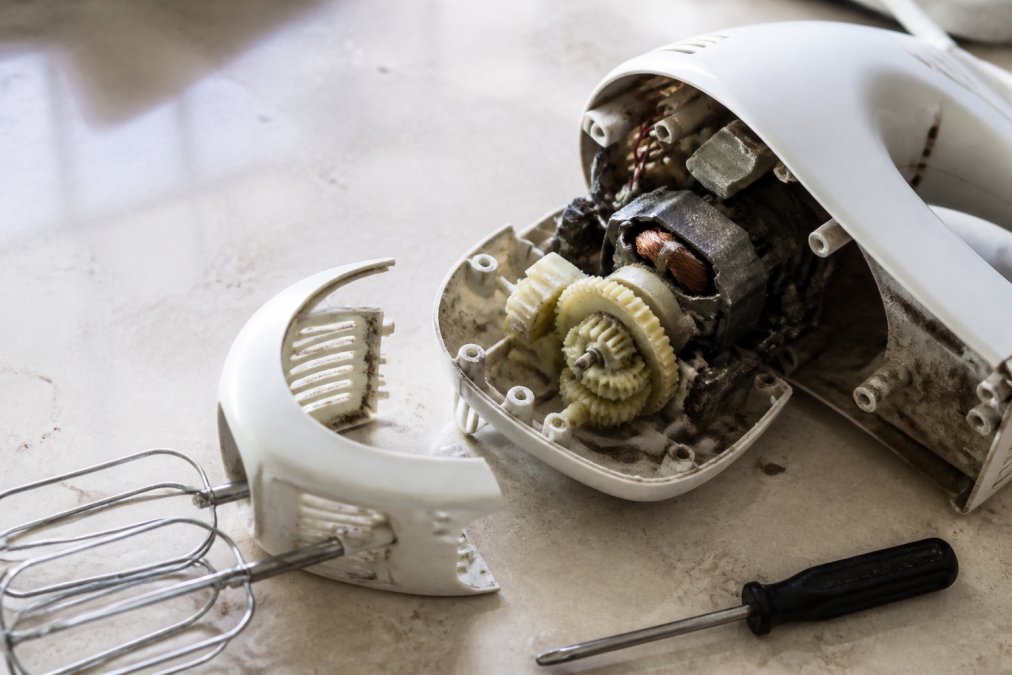
The bigger culprit is often manufacturing quality. To hit aggressive price points, many brands now use plastic gears where metal once stood, thinner gauge wiring, and sealed motors that cannot be serviced. This shift is documented across the industry, with repair advocates noting that the growing complexity and sealed design of modern appliances reduces their repairability. A hand mixer from twenty years ago had a metal gearbox you could open and fix; many current models are glued shut, making a single stripped plastic gear the end of the whole unit.
But the story does not stop at the brand's design desk. The real driver of this quality decline sits further up the supply chain. Most appliance brands, even well-known American names, do not manufacture their own motors, gears, or control boards. They source these components from a small number of global suppliers, primarily concentrated in East Asia, where contracts are awarded on cost-per-unit above all else. A brand may specify a motor rated for 500 hours of continuous use, but if the supplier substitutes a cheaper winding wire or a thinner bearing, the finished product may only deliver 150 hours (peer-reviewed research). Unless the brand performs destructive teardown testing on every production batch, which most do not, those substitutions go unnoticed until consumers start posting failure reviews six months later.
This creates a systemic problem: the brand's reputation suffers, but the financial risk has been pushed onto the supplier, who has already been paid. The consumer is left holding a gadget that failed not because of a grand conspiracy to force a repurchase, but because the lowest bidder won the contract for a component that nobody ever sees.
There is also a regulatory dimension that most consumers never consider.
This is not to say that every modern gadget is destined to fail early. The brands that stand out in durability testing are the ones that specify higher-grade components, perform regular teardown audits on supplier production, and design for serviceability. But those practices cost money, and in a market where a $30 blender and a $300 blender sit side by side on the shelf, the pressure to cut internal costs is relentless.
Common Failure Points: Where Kitchen Gadgets Break First
Most breakdowns are not mysterious. Based on common technician reports and consumer patterns, failures concentrate in a few specific areas. The most frequent issues involve the motor, the control board, and the mechanical drive components.
- The motor suffers from thermal stress and motor burnout when it is overworked or when ventilation is blocked.
- The control board and circuit board fail due to power surges or moisture ingress, often killing a gadget that otherwise looks perfect.
- The drive system fails when plastic gears strip under normal mechanical wear, especially in mixers and blenders.
Sensor failure is another growing issue. As gadgets add smart features and Wi-Fi connectivity, they introduce more points of failure that have nothing to do with the core function of chopping or blending. A food processor that relies on a touchscreen interface will stop working if that screen dies, even if the blade and motor are perfectly fine. This complexity is a direct trade-off against appliance longevity.
Signs of Poor Quality Kitchenware to Spot Before You Buy
You can avoid most frustration by learning to spot signs of poor quality kitchenware before you hand over your money. The first red flag is weight; a gadget that feels surprisingly light usually indicates thin plastic housing and lightweight internal components. The second is the presence of non-replaceable parts, such as sealed batteries or riveted casings that prevent access.
Check the power cord thickness and the quality of the plug. A flimsy cord is a strong indicator of cost-cutting elsewhere. Look for visible seams and rough edges on plastic parts, which suggest low manufacturing standards. Finally, be wary of proprietary parts. If the manufacturer uses a unique, non-standard filter or blade attachment, you will be forced to buy replacements from them at a premium, and the gadget becomes useless if they discontinue the part.
How to Choose Durable Kitchen Tools That Last
When you are learning how to choose durable kitchen tools, focus on the material of the components that do the actual work. For blades, look for stainless steel rather than stamped metal. For gears and housings, prioritize metal or heavy-duty reinforced plastic. The best rule of thumb is to ask whether the tool can be disassembled for cleaning and repair; if it cannot, its service life is limited by its dirtiest part.
For manual tools, the calculation is simpler. A solid stainless steel garlic press with an ergonomic design will outlast five plastic ones because it has no motor to burn out and no circuit board to fail. Similarly, a simple heat sealer or vacuum sealer with one-button operation and minimal electronics is inherently more reliable than a multi-function device with dozens of modes you will never use.

Repair vs Replace Kitchen Gadgets: A Practical Guide
When a gadget dies, you face the repair vs replace kitchen gadgets decision. Start by checking the warranty coverage, as many failures within the first year are covered. If the unit is out of warranty, evaluate the cost-to-repair ratio. As a general guide, if the repair estimate exceeds half the price of a new, comparable unit, replacement is usually the smarter financial move.
For DIY troubleshooting, run through a quick diagnostic checklist before giving up. Check if the unit is receiving power, inspect the power cord for breaks, and clean out any debris blocking the motor ventilation. Many failures are simple user error, such as a clogged filter or an improperly seated attachment.
| Failure Symptom | Likely Cause | Best Action |
|---|---|---|
| Motor runs but blade won't spin | Stripped plastic gear | Replace unit |
| Unit won't power on | Blown circuit board or fuse | Check warranty; if expired, replace |
| Intermittent operation | Loose wiring or overheating | Clean vents; if persists, replace |
| Leaking from base | Failed seal or gasket | Try replacement seal if available |
Before you make the call, however, ask one more question: can you even get the part? This is where the repair-versus-replace decision stops being about math and starts being about policy. Over the past decade, a growing number of kitchen gadgets have moved toward proprietary designs that lock out third-party repair. Some brands use tamper-resistant screws that require specialized bits. Others refuse to sell replacement parts to independent repair shops, forcing consumers to use authorized service centers that often charge more than the gadget is worth. And a growing number of smart appliances require software authentication, a replacement control board will not work unless it is paired to the manufacturer's cloud server, which means the company effectively controls whether your $400 espresso machine can be fixed at all.
The environmental impact of disposable appliances is a growing concern. The e-waste from discarded gadgets is a real problem, and the Right to Repair movement advocates for legislation that forces manufacturers to provide parts and manuals. Supporting brands that design for repairability and offering your old gadgets to recyclers are two practical ways to reduce your footprint.
When you do decide to replace a broken gadget, factor repairability into your buying decision. Look for brands that publish service manuals, sell replacement parts directly to consumers, and use standard fasteners rather than proprietary ones. A gadget that costs $20 more upfront but can be repaired for $15 in three years is a better investment than a cheaper model that becomes landfill the first time a gear strips.
Conclusion
The question of why do kitchen gadgets break quickly usually has less to do with your usage and more to do with the manufacturing decisions made before the product reached your shelf. By favoring simpler designs, metal components, and repairable construction, you can dramatically extend the appliance lifecycle of your kitchen tools and save money in the long run.
At Oatmehome, we focus on practical reliability over fleeting features. Our range of kitchen essentials, from stainless steel presses to compact sealers, prioritizes straightforward design that holds up to daily use. Get started with Oatmehome and equip your kitchen with tools built to last.
Frequently Asked Questions
Why do new kitchen gadgets break so fast compared to older models?
Newer gadgets often use more plastic components, including plastic gears and housings, which wear down faster than the metal parts used in older models. Manufacturers also design products with planned obsolescence, meaning they expect a shorter service life. Modern features like touchscreens and smart connectivity add more circuit boards and sensors that can fail, while the core motor or mechanism may not be built to the same standard.
What is the 50/50 rule for appliance repair versus replacement?
The 50/50 rule is a simple guideline: if the repair cost is more than half the price of a new gadget, you should replace it. This makes sense because a new item comes with a warranty and updated components. For a $20 gadget, a $15 repair is rarely worth it. For a $200 mixer, a $90 repair might be a smart move.
What are the signs of poor quality kitchenware before I buy it?
Check the weight and materials. If a gadget feels very light and is mostly plastic, it may not hold up. Look for visible seams in plastic that can crack under stress. Try the buttons and handles in the store; they should feel solid, not flimsy. A very low price often signals cheap components, but a high price does not guarantee quality, so read reviews about long-term durability.
How can I make my kitchen gadgets last longer?
Follow the maintenance schedule in the manual, which often includes cleaning filters and removing food debris. Avoid overloading motors, which causes burnout. Clean coils on appliances like refrigerators to prevent thermal stress. Store gadgets properly to avoid mechanical wear. Simple habits like hand-washing items with plastic gears and keeping them away from heat can extend their lifespan significantly.