

At-Home Alternative for Kitchen Organization: 2026 Guide
Table of Contents
- Why Traditional Kitchen Organization Falls Short
- How to Organize a Kitchen Without a Pantry: Zone by Zone
- Small Kitchen Storage Hacks That Actually Work
- Best Kitchen Organization Brands for Curated, Durable Solutions
- How to Declutter and Purge Before You Organize
- Sustainable and Ergonomic Choices for a Better Kitchen Workflow
- Conclusion: Build a Kitchen That Works Around Your Space
- Frequently Asked Questions
Last Updated: September 5, 2026
Why Traditional Kitchen Organization Falls Short
Most kitchens assume you have a pantry and plenty of cabinets. The reality for renters, apartment dwellers, and owners of older homes is a frustrating mismatch between the layout you have and the storage you need. That mismatch is why an at-home alternative for kitchen organization matters more than buying another set of matching containers.
Traditional solutions assume permanent installation and generous square footage. When you cannot drill into walls, counter space is measured in inches, or the nearest cabinet is across the room, the standard advice breaks down. The workaround is to think in zones rather than rooms.
At Oatmehome, we focus on practical, thoughtfully selected household solutions. The conclusion: effective organization is less about what you buy and more about how you assign functions to overlooked areas.
How to Organize a Kitchen Without a Pantry: Zone by Zone
The most effective strategy for a pantry-less kitchen is to divide the room into functional zones: vertical surfaces, cabinet doors, the sink area, and countertops. Each zone solves a specific storage problem, and together they rival a walk-in pantry for everyday efficiency.
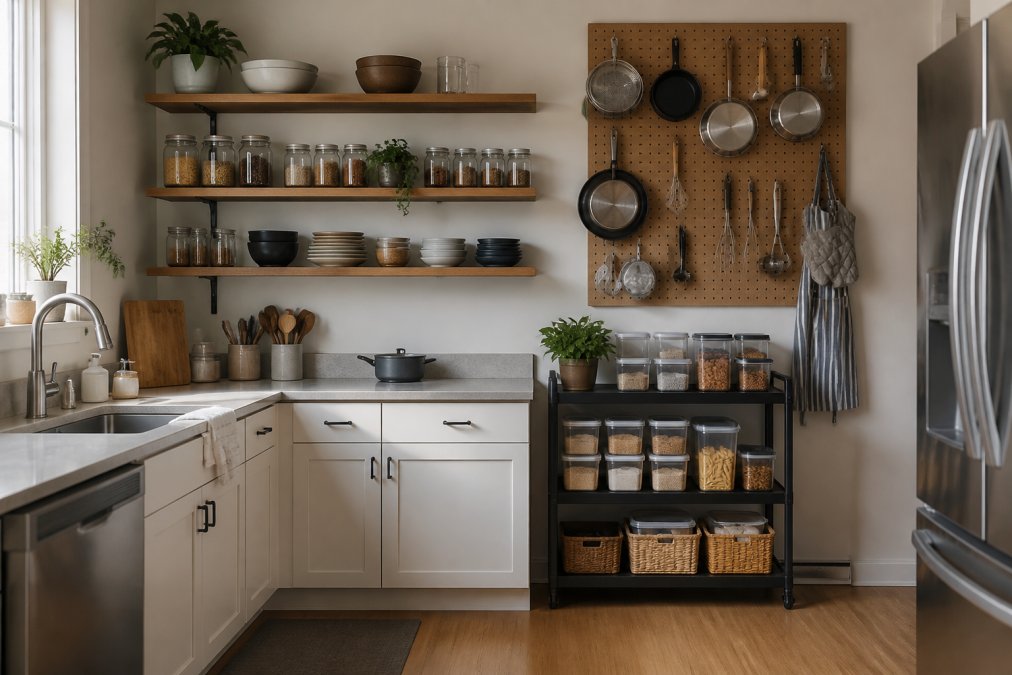
Zone 1: Maximize Vertical Storage with Wall-Mounted Organizers
When floor and counter space are scarce, the walls become prime real estate. Floating shelves and wall-mounted rails keep frequently used items visible and accessible, reducing clutter and shortening your workflow. For renters, look for adhesive hooks and rails that hold moderate weight without permanent damage.
Store daily-use items at eye level, reserving higher shelves for occasional cookware. A pegboard is flexible because you can rearrange hooks as your tool collection changes.
Zone 2: Creative Pantry Alternatives Using Cabinet Doors and Tension Rods
Cabinet doors are the most underused storage surface in most kitchens. An over-the-door organizer with clear pockets holds spices, condiment packets, or cleaning supplies without taking up shelf space. Inside the cabinet, adhesive hooks hold measuring spoons or pot lids flat against the panel.
Tension rods create instant shelves in awkward gaps. Install one vertically between the counter and an upper cabinet to hold cutting boards or baking sheets, or horizontally under the sink to hang spray bottles. Stackable containers with airtight lids turn existing shelves into a dry goods system.
Zone 3: Under-Sink Storage and Countertop Management
The under-sink area is often wasted space, yet it is ideal for cleaning supplies and infrequently used items. A tension rod can hang spray bottles, while a small stackable drawer unit organizes sponges, brushes, and spare bags. Keep the area dry and ventilated.
On the countertop, limit visible items to those used multiple times a day. A retractable sink rack expands your workspace for drying dishes or produce, then rolls up for compact storage. The Retractable Stainless Steel Sink Rack at $24.99 adds surface area without permanently occupying it.

Small Kitchen Storage Hacks That Actually Work
The best small kitchen storage hacks solve a specific spatial problem rather than adding generic bins. Each method below targets a particular pain point. Implement them in order of your biggest frustration.
- Magnetic strips on the wall or inside a cabinet door hold knives and metal tools, freeing drawer space and keeping blades visible.
- Pegboards with hooks and small shelves adapt to changing needs, holding everything from pots to utensils.
- Over-the-door organizers with mesh pockets expand storage without any installation.
- Tension rods create vertical dividers for baking sheets and cutting boards, or horizontal hanging space for spray bottles.
- Drawer dividers keep utensils and tools separated so every item has a defined place.
- Stackable containers with clear sides let you see contents at a glance and maximize the height of each shelf.
Magnetic Strips, Pegboards, and Over-the-Door Organizers
These three tools form the backbone of a flexible, renter-friendly system. Magnetic strips are best for knife storage, keeping blades off the counter and out of drawers where they dull against other metal. Pegboards excel at holding bulky cookware that does not stack well and are easy to reconfigure.
Over-the-door organizers work on cabinet doors, pantry doors, and even the laundry room door. Choose one with clear pockets so you can identify contents without opening each one.
Rental-Friendly Solutions: No Drilling Required
Renting does not mean living with disorganized cabinets. Damage-free adhesive hooks, command strips, and suction cup organizers handle surprising weight loads and remove cleanly when you move out.
A utility cart is the ultimate rental-friendly addition because it requires no installation. It provides mobile storage for produce, appliances, or pantry overflow and rolls into a closet when you need floor space.
Best Kitchen Organization Brands for Curated, Durable Solutions
When building a system that must last, the source of your storage tools matters as much as the layout. Oatmehome offers a curated range of practical, everyday functionality. Our products are designed to simplify daily projects and emphasize reliable design.
For example, the Foldable Kitchen Chopping Board at $22.99 transforms from a cutting surface into a rinse basket, collapsing flat for storage. The 9-in-1 Drain Basket at $29.99 combines slicing and washing in one step, reducing prep time and cleanup.

| Product | Price | Primary Function | Best For |
|---|---|---|---|
| Kitchen Sink Drain Basket Organizer | $10.99 | Holds sponges, soap, or produce in sink corner | Keeping sink edges clear |
| Retractable Sink Rack | $24.99 | Adds drying or prep space over the sink | Expanding counter workspace |
| Foldable Chopping Board | $22.99 | Chopping board that folds into a rinse basket | Multi-step prep in tight spaces |
| 9-in-1 Drain Basket | $29.99 | Slices and rinses vegetables in one tool | Reducing prep and cleanup time |
| Mini Heat Bag Sealer | $14.99 | Reseals opened food bags | Reducing food waste |
A common mistake is buying a full matching set of containers before measuring your actual shelf depths and door heights. Measure each space first, then select individual pieces that fit. The Mini Heat Bag Sealer at $14.99 keeps dry goods fresh, reducing waste and the need for excessive container storage.

How to Declutter and Purge Before You Organize
Organization is impossible without decluttering first. Every item you keep needs a designated home, so the fewer items you own, the simpler your system becomes. The standard advice to sort into 'keep,' 'donate,' and 'discard' piles fails because it does not give a decision framework for gray-area items. Here is a more rigorous method.
Step 1: Empty One Zone Completely, Not One Cabinet
Most decluttering guides tell you to start with a single cabinet. That is a mistake. A cabinet is part of a functional zone (e.g., the coffee station, the baking area, the prep zone). Emptying just one cabinet leaves you unable to see duplicates across adjacent storage. Instead, pick a zone, for example, everything related to baking, and pull every item from all cabinets, drawers, and shelves that belongs to that activity.
Step 2: Apply the Four-Box Test
For each item, ask four questions in order. If it fails any question, it goes to the appropriate box.
- The Last-Used Test: Have you used this item in the last 12 months? If no, it goes to the donate or discard box. The only exceptions are seasonal items (e.g., a turkey roaster used once a year) and true emergency tools (e.g., a manual can opener during a power outage).
- The Duplicate Test: Do you own another item that performs the same function? If yes, keep the one that is better made, easier to clean, or more frequently used. The duplicate goes to the donate box unless it is genuinely worn out, in which case it is discarded.
- The Single-Function Test: Does this item do only one thing, and can a multi-function tool you already own do that same job? A dedicated avocado slicer fails this test if you own a chef's knife. A citrus reamer passes if you juice citrus more than once a week. Single-function gadgets that fail this test are prime candidates for donation.
- The Space Test: Does this item have a designated home in your current zone plan? If you cannot assign it a specific spot on a shelf, in a drawer, or on a wall hook, it will become clutter again within a week. If it fails this test, it goes to the donate box.
Step 3: Handle the 'Maybe' Pile with a Temporary Box
Even with the four-box test, you will have uncertain items. Do not let them linger on the counter. Place them in a clearly labeled cardboard box, seal it, and write today's date on the side. Store it in a closet, under the bed, or in the trunk of your car. Set a reminder for 90 days. If you have not opened that box by day 90, donate the entire box without opening it.
Step 4: Measure Before You Buy Replacement Storage
A common failure pattern is decluttering, then immediately buying new organizers to fill the emptied space. Before purchasing any bins, racks, or dividers, measure the interior height, depth, and width of the shelves and drawers you just cleared. Most standard cabinet shelves are 11 to 12 inches deep, but upper cabinets in older homes can be as shallow as 9 inches. Bring your measurements to the store or keep them on your phone.
Step 5: The 24-Hour Rule for Sentimental Items
Kitchens are full of sentimental items: your grandmother's mixing bowl, a wedding gift you never registered for, a souvenir mug from a trip. These clog your system because they carry emotional weight. Place sentimental items in a single box. If the box has more than five items, choose which five matter most. The rest are photographed (so you keep the memory) and then donated or gifted to a family member who will use them.
Step 6: The Final Pass for Expired and Worn Items
After sorting by zone, do a final sweep for expired food, worn non-stick pans, and dull knives. Ground spices lose potency after six months and are effectively flavorless after a year (the FDA). Examine non-stick cookware for scratches or flaking; once the coating is compromised, it can leach into food and should be discarded. Test knife sharpness by slicing a tomato; if it squashes instead of slicing cleanly, the knife needs sharpening or replacement. These items belong in the trash or a recycling program.
This zone-based, criteria-driven method is more work than a single afternoon of sorting, but it produces a kitchen where every remaining item has a purpose and a place, a system that stays organized for months, not days.
Sustainable and Ergonomic Choices for a Better Kitchen Workflow
Most kitchen organization guides stop at 'where to put things.' They ignore two factors that determine whether your system works over the long term: how your body moves through the space, and what your storage tools are made of.
The Ergonomic Triangle, Adapted for Non-Traditional Kitchens
Professional kitchen designers use the 'work triangle' concept: sink, stove, and refrigerator should form a triangle with legs between 4 and 9 feet (extension.umn.edu). In a pantry-less apartment kitchen, that triangle is often compressed or broken. The fix is not to rearrange appliances but to reorganize your storage around the triangle you actually have.
The reach rule: Store your most frequently used items, cooking oil, salt, your primary chef's knife, cutting board, within a 12-inch reach of your dominant hand at the primary prep surface. Right-handed items belong to the right of the stove or prep area; left-handed items to the left. This single adjustment reduces wasted motion more than any shelf organizer.
The lift rule: Heavy items (cast iron skillets, Dutch ovens, stand mixer bowls) belong between hip and shoulder height. Lifting a 12-pound cast iron skillet from a low cabinet requires bending and twisting, a leading cause of kitchen back strain (the CDC). If your only storage for heavy cookware is a low cabinet, install a pull-out drawer base or a rolling cart. For high shelves, store only lightweight, infrequently used items.
The bend rule: Daily-use items, plates, glasses, coffee mugs, everyday spices, belong between waist and eye level. Weekly items (mixing bowls, blender) can go lower. Monthly or less items (slow cooker, roasting pan) can go on the highest or lowest shelves. This vertical zoning prevents constant stooping and reaching.
Material Choices That Last: A Practical Comparison
Sustainability in kitchen organization is not about buying 'eco-friendly' products once. It is about buying fewer, better-made items that survive years of daily use. Here is how common materials compare on durability, maintenance, and end-of-life.
Bamboo: Bamboo is harder than most hardwoods, making it a solid choice for drawer dividers, countertop organizers, and cutting boards. It resists moisture better than pine or oak, but it is not waterproof and should be wiped dry after exposure to standing water. At end of life, bamboo is compostable in industrial facilities, though most municipal programs do not accept it. Expect a lifespan of 3 to 5 years.
Stainless Steel: For items that see constant water contact, sink caddies, drying racks, under-sink organizers, stainless steel is the most durable option. Look for 18/8 or 304 grade, which resists rust and corrosion. It is fully recyclable, and a well-made steel rack can last 10 years or more. The trade-off is weight and cost; steel typically costs 30 to 50 percent more than plastic.
Food-Grade Silicone: Silicone is not a structural material for shelves or bins, but it excels for collapsible items like the retractable sink rack's arms or foldable colanders. It is heat-resistant to 400°F, does not harbor bacteria, and is BPA-free. It is not biodegradable, but a quality silicone item should last 5 to 7 years.
Polypropylene Plastic (the default): Most clear storage bins are made from polypropylene (recycling code #5). It is lightweight, shatterproof, and recyclable in most curbside programs. The problem is not the material but the thin-gauge products that crack within a year. If you buy plastic, choose bins with a wall thickness of at least 2 millimeters and reinforced rims.
Upcycled Alternatives That Work
Before buying anything, look around your home for items that can be repurposed. Clean glass jars with wide mouths (pasta sauce, pickle jars) make excellent dry goods storage; they are airtight, see-through, and free. Remove labels by soaking in warm soapy water and scrubbing with baking soda. Metal baking trays with raised edges become makeshift drawer dividers. A wooden wine crate, sanded and sealed with food-safe mineral oil, becomes a countertop potato and onion bin.
The Mobility Factor: Designing for Limited Reach
For anyone with limited mobility, arthritis, or a temporary injury, standard kitchen organization advice can be actively harmful. High shelves become inaccessible; low cabinets require painful bending. The adaptations are simple but rarely discussed.
- Pull-out shelves or rolling carts eliminate the need to reach into deep cabinets. A rolling utility cart with locking wheels can be positioned next to the prep area and moved out of the way when not needed.
- Magnetic strips mounted at waist height keep knives and metal utensils accessible without opening a drawer or reaching overhead.
- Suction cup hooks on the inside of the sink cabinet door hold frequently used cleaning supplies at a reachable height.
- Lightweight alternatives matter. A 2-quart stainless steel saucepan weighs roughly 2.5 pounds empty; a comparable aluminum version weighs about 1.5 pounds. For someone with limited grip strength, that one-pound difference is significant. Prioritize keeping lighter cookware at accessible heights.
Conclusion: Build a Kitchen That Works Around Your Space
The core challenge of a pantry-less kitchen is not a lack of space, but a lack of a system that fits the space you have. By dividing your kitchen into zones, using vertical and door-mounted storage, and choosing durable, multi-functional tools, you build an at-home alternative for kitchen organization that works with your layout.
The most effective kitchen organization effort starts with decluttering, then adds storage in a logical order: walls first, then cabinet doors, then under-sink and countertop areas. Rental-friendly options like tension rods, adhesive hooks, and utility carts deliver most of the benefit of permanent fixtures without the risk of losing your security deposit.
Oatmehome offers a curated range of kitchen essentials designed for exactly these constraints, from sink-side organizers to space-saving prep tools, all focused on practical functionality and reliable materials. Get started with Oatmehome and build a kitchen that makes cooking, cleaning, and organizing more efficient, no matter the size of your space.
Frequently Asked Questions
How can I organize my kitchen if I don't have a pantry?
Divide your kitchen into zones and use vertical space. Install floating shelves or a pegboard for frequently used pots and tools. Use tension rods inside cabinets to create shelf levels, and add over-the-door organizers for cleaning supplies or spices. A rolling utility cart can store produce or small appliances and tucks away when not in use. Focus on keeping daily-use items within arm's reach and storing overflow items in labeled bins, which keeps kitchen organization simple without a dedicated pantry.
What are the most durable materials for kitchen storage solutions?
Stainless steel is rust-resistant and handles heat well, making it a top choice for sink racks and drying stations. Food-grade polypropylene (PP) plastic is lightweight, stain-resistant, and safe for food contact, ideal for bins and cutting boards. Bamboo is a renewable option that resists moisture when sealed. When buying, look for rust-proof metals and BPA-free plastics to ensure the organizers hold up to daily use without warping or corroding.
How do curated home goods brands compare to mass-market retailers for kitchen organization?
Curated brands like Oatmehome focus on a smaller range of items they have tested for functionality, often using higher-grade materials like stainless steel and BPA-free silicone. Mass-market retailers offer more variety but often at the cost of consistent quality. A curated approach usually means each product solves a specific problem well, so you may pay slightly more but avoid replacing items after a few months. This makes them a smart choice for durable kitchen organization.
What are the best budget-friendly alternatives for kitchen organization?
The most budget-friendly options include tension rods, which cost a few dollars and create instant shelving, and adhesive hooks that require no drilling. Over-the-door shoe organizers work well for storing spices or cleaning supplies. Repurpose mason jars for dry goods and use stackable containers you already own. For around $10.99, a sink drain basket organizer adds space for sponges or produce, and a $14.99 mini heat bag sealer keeps opened food fresh, preventing waste and saving money over time.
Is it better to buy kitchen organizers in sets or individually?
Buy individually first. Measure your specific drawers, cabinets, and sink area before purchasing anything. Sets often include pieces that do not fit your space, leaving you with wasted money. Individual pieces let you solve your most pressing problem first, such as a retractable sink rack for $24.99 to free up counter space. Once one zone works well, move to the next. This piecemeal approach ensures every item earns its place and fits your kitchen layout perfectly.
This article was written using GrandRanker