

Best Kitchen Tools for New Apartments: 2026 Guide
Table of Contents
- What Makes a Kitchen Tool Worth Buying for a Small Space
- Space-Saving Kitchen Gadgets That Earn Their Counter Space
- Essential Kitchen Appliances for Small Apartments
- How to Organize Small Kitchen Cabinets Without Renovating
- Prep Tools and Cutting Boards for Tight Counters
- Food Storage and Freshness Tools for Apartment Kitchens
- Rental-Friendly and Eco-Friendly Kitchen Upgrades
- Frequently Asked Questions
Last Updated: September 10, 2026
What Makes a Kitchen Tool Worth Buying for a Small Space
The best kitchen tools for new apartments do more than one job, and the right kitchen tools store in less space than a full-size version.
A kitchen tool earns its place in a small apartment when it clears three tests at once:
- It replaces at least two other items. A foldable chopping board that doubles as a drain basket frees up the cabinet space a colander would have taken.
- It collapses, folds, or nests. Anything that can't flatten has to justify the footprint it holds permanently on your counter.
- It survives daily use without special care. Dishwasher-safe, rust-resistant materials matter more in a rental, where you can't install a better drying setup.
The U.S. Department of Housing and Urban Development tracks housing cost burdens that push many renters into smaller units, which is exactly why multi-functional design has become the deciding factor rather than a nice-to-have. Below, we'll show you which tools genuinely pull their weight, and which ones to leave on the shelf.

Space-Saving Kitchen Gadgets That Earn Their Counter Space
A space-saving kitchen gadget earns its spot only if it replaces something bulkier or eliminates a step. Everything else is clutter with a marketing budget.
The Retractable Stainless Steel Sink Rack ($24.99) is the clearest example. It rolls out over the sink for draining dishes or defrosting meat, then rolls up and slides into a drawer, a dish rack and colander in one, with zero permanent counter space.

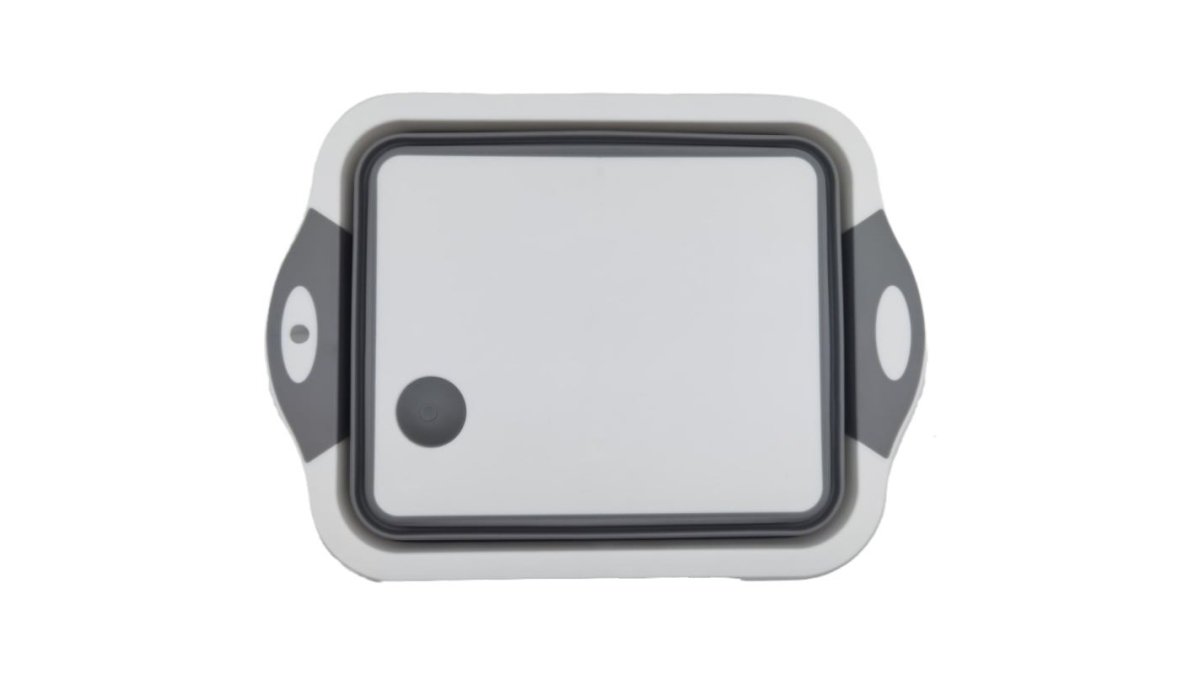
The Foldable Kitchen Chopping Board ($22.99) does the same for prep: it works as a cutting surface, folds into a basket for rinsing, and has a drain plug for emptying water without lifting it.
The trade-off: folding boards have a shorter lifespan than a solid wood block, and the hinges wear first.
Multi-Functional Tools vs. Single-Use Gadgets
Multi-functional tools beat single-use gadgets in small kitchens because they cut the total number of objects you store, not just the size of each. An avocado slicer takes roughly the same drawer space as a garlic press, but the garlic press handles garlic, ginger, peanuts, and nuts.
The 9-in-1 Drain Basket ($29.99) is the strongest argument for this approach. It slices, peels, and chops with interchangeable blades, then rinses everything in the same basket, one item replaces a slicer, peeler, chopper, and colander.
Where single-use tools still win: anything you use several times a day. A dedicated vegetable peeler you grab constantly is worth its drawer space. A strawberry huller you use twice a year is not.
Essential Kitchen Appliances for Small Apartments
The essential kitchen appliances for small apartments handle a task you repeat weekly and fit in a cabinet when you're done. Everything else competes for the same two outlets.
| Appliance | Price | Best For | Storage Footprint |
|---|---|---|---|
| Portable Foldable Silicone Electric Kettle | $33.99 | Boiling water fast, travel | Folds flat, fits a backpack |
| 2-Tier Egg Cooker & Steamer | $21.99 | Breakfast meal prep | Compact, single shelf |
| Digital LCD Measuring Cup Scale | $20.99 | Baking and precise cooking | Cup detaches, nests easily |
The Portable Foldable Silicone Electric Kettle ($33.99) is the standout for renters. It boils water in under two minutes, holds 0.6 liters, folds small enough for a lunch bag, and comes with a detachable cord and a one-year warranty.

The 2-Tier Egg Cooker & Steamer ($21.99) handles soft-boiled, hard-boiled, and steamed eggs in one compact unit, covering most weekday breakfasts without a stovetop pan.
One honest limitation: foldable silicone kettles aren't built for a household that boils water six times a day. The silicone flexes over time.
What to Skip When You Have Limited Outlets
Skip anything that needs a dedicated outlet and only does one thing. A panini press, a separate rice cooker, and a waffle iron claim three outlets and three cabinet shelves for occasional use, a stovetop pot covers all three tasks.
The rule: if two appliances overlap in function, keep the one that stores smaller. Your limited outlets are better spent on a kettle and a multi-purpose cooker than on four single-task machines.
How to Organize Small Kitchen Cabinets Without Renovating
You organize small kitchen cabinets without renovating by adding vertical layers inside the space you already have, not by buying more storage furniture. Renters can't drill or install shelving, so every fix must be removable and reversible at move-out.
Measure before you buy anything. Standard upper cabinets run about 12 inches deep and 30 to 36 inches tall, but the usable interior shrinks once you account for the door hinge and shelf lip. A riser 1 inch too wide won't fit; a bin 1 inch too tall blocks the door. Measure interior width, depth, and shelf gaps before you shop.
A workable sequence for a single cabinet:
- Empty it completely and sort into three piles: daily, weekly, and occasional.
- Move daily items to the middle shelf at eye level, where you reach without bending.
- Add a stackable riser or two-tier rack to create a second layer under each shelf, the highest-yield move in a small cabinet, doubling usable surface without adding footprint.
- Use the cabinet door with over-door hooks for measuring cups, light utensils, and pot lids. The door is dead space in almost every rental kitchen.
- Corral small items in one bin instead of letting them scatter. One bin you pull out beats ten loose objects you dig through.
A few renter-specific mechanisms that survive a move-out inspection:
- Over-the-door organizers hook onto the existing cabinet door with no adhesive or screws. They hold foil, plastic wrap, and cutting boards that would otherwise lie flat and waste vertical space.
- Stackable wire risers create a second tier inside a cabinet. Check the weight rating, a riser rated for light items will bow under cast iron.
- Adhesive-backed magnetic strips mount on a cabinet side or the wall beside the stove for knives and metal utensils. Use removable adhesive strips so the surface isn't damaged when you take them down.
- Under-shelf baskets hang from an existing shelf and use the empty air below it, ideal for produce, wraps, and cleaning supplies.
The biggest mistake is buying organizers before you've measured. Cabinet interiors vary more than outside dimensions suggest, and a rack 1 inch too wide is useless. Measure first, then buy to the measurement.
For sink-adjacent clutter, the Kitchen Sink Drain Basket Organizer ($10.99) mounts with suction cups, no drilling, nothing to patch at move-out. It holds sponges, soap, or produce in the corner space most sinks waste. Pair it with an over-the-door hook below the sink for a trash bag roll, and you've reclaimed two dead spots.
Prep Tools and Cutting Boards for Tight Counters
Prep tools for tight counters should collapse, nest, or hang. A cutting board that lives permanently on the counter costs you the only workspace you have.
The Digital LCD Measuring Cup Scale ($20.99) is the tool most small kitchens don't know they need. It weighs and measures in one cup, converts flour, sugar, milk, water, and oil from weight to volume automatically, and the cup detaches for storage. One item replaces a measuring cup set and a kitchen scale.
For garlic and ginger, the Stainless Steel Garlic Press ($14.99) is a compact win. It's 10.7 cm long, made from 304 stainless steel, and the arc-shaped handle works even with a weaker grip.
Where it falls short: cleaning garlic out of the perforations takes a rinse and a brush.
U.S. Department of Agriculture food safety guidance recommends washing produce and surfaces thoroughly to reduce cross-contamination, which is easier when your cutting board can be rinsed and folded into a basket rather than carried across the kitchen.
Food Storage and Freshness Tools for Apartment Kitchens
Food storage tools matter more in an apartment because you have less refrigerator space per person and less room for backup containers. Sealing food properly is the difference between a full shelf and a shelf of half-stale bags.
The Mini Heat Bag Sealer ($14.99) reseals snack bags, dried fruit, tea, and chips with a single slide. It runs on two AA batteries, fits in a drawer, and seals tighter than a clip or twist tie. It's not for pure paper bags, and bags thicker than 0.1 cm may need a slower pass, so read the instructions first.
For containers, prioritize square and rectangular shapes over round ones. Round containers waste the corners of every shelf and drawer, in a small fridge, that adds up to a missing shelf's worth of capacity.
Rental-Friendly and Eco-Friendly Kitchen Upgrades
Rental-friendly upgrades and eco-friendly choices usually point to the same products: items that mount without drilling and last long enough not to be replaced every year. That overlap is the strategy, a durable, removable tool serves both goals at once.
Upgrades That Don't Touch the Walls
The constraint in a rental is the security deposit. Anything requiring a drill, screw, or permanent adhesive risks a repair charge. The workaround: mounting methods that hold firmly but release cleanly.
- Suction-mounted organizers stick to tile, glass, and smooth laminate, the surfaces most apartment kitchens already have. They hold sponges, soap, and small tools beside the sink with no hardware, release with a twist, and leave nothing to patch.
- Over-the-door hooks and racks hang on existing cabinet doors and use the dead space behind them. No adhesive, no screws, and they move with you.
- Removable adhesive strips (pull-to-release) hold light magnetic strips and small hooks on painted walls. Follow the weight rating, most are rated for a few pounds, not a knife block.
- Magnetic knife strips mount on a refrigerator side or metal cabinet with no wall contact at all, the cleanest rental option for knives, since the fridge is already there.
- Freestanding risers and stackable shelves sit inside cabinets and on counters without attaching to anything, the lowest-risk upgrade because there's nothing to undo.
Before buying any mount, press it onto the surface, load it with the weight you plan to store, and leave it a day. If it holds, it'll hold. If it slides, return it.
The Eco-Friendly Overlap
Eco-friendly choices in a rental kitchen come down to two levers: buy durable so you replace less, and cut single-use waste at the source. Both are cheaper over a lease term than the disposable alternative.
- Reusable over disposable. A foldable silicone container or stainless steel bottle replaces hundreds of single-use items a year. Higher upfront cost, far lower per-use cost.
- Durable over cheap. Stainless steel and food-grade silicone outlast thin plastic organizers that crack within months. Buying once beats replacing a cheap version three times.
- Reseal over re-buy. The Mini Heat Bag Sealer ($14.99) reseals snack bags, dried fruit, tea, and chips with a single slide, runs on two AA batteries, and fits in a drawer. Resealing keeps food from going stale, the most direct waste reduction in a kitchen.
- Refill over replace. A soap-dispensing sponge rack lets you refill from a larger bottle instead of buying a new small bottle each time, cutting plastic and cost.
The Double Layer Sponge & Soap Rack ($14.99) is a small example with a real payoff. Fill the dispenser with dish soap and press the sponge to release the right amount, cutting soap waste and the number of bottles on your sink edge. It's made from ABS plastic and works with any sponge.
U.S. Environmental Protection Agency on reducing household waste notes that durable, reusable items reduce waste at the source, which is exactly what a foldable board, a resealable bag sealer, or a refillable soap dispenser does over its lifetime.
On durability: no kitchen tool is permanent, and silicone flexes over time like any material.
Frequently Asked Questions
What are the essential kitchen items I need for my new apartment?
Start with a chef's knife, a cutting board, a non-stick pan, a saucepan, mixing bowls, measuring cups, tongs, a spatula, a colander, and storage containers. From there, add tools that do double duty, like a foldable chopping board that also works as a drain basket or a digital measuring cup that replaces both a scale and a measuring jug. Buy the basics first, then add appliances as you notice what you actually reach for.
Which space-saving kitchen gadgets save the most room?
Collapsible and foldable tools save the most room because they flatten for drawer storage. A foldable chopping board that doubles as a basket, a retractable sink rack that rolls up, and a portable foldable kettle that collapses to a few centimeters all free up cabinet and counter space. Multi-function tools beat single-use gadgets in apartments because each one replaces two or three items you would otherwise have to store.
What are the best kitchen appliances for apartments?
Compact appliances that handle one job well and store easily win in apartments. A 2-tier egg cooker and steamer handles breakfast without a stovetop, a portable foldable kettle boils water in under two minutes and folds flat, and a digital measuring cup scale replaces both a scale and measuring cups. Skip anything bulky that only does one thing, especially if you have limited outlets and counter space.
How do you organize a small kitchen with limited cabinet space?
Use vertical space first: stack shelves, hang suction-cup organizers inside cabinet doors, and group items by how often you use them. Keep daily tools at eye level and seasonal or occasional items up high. Corner sink organizers and triangular drain baskets use dead space that would otherwise sit empty. The goal is to give every item a fixed spot so nothing ends up piled on the counter.
Do I need a full cookware set for a first apartment?
No. A full set usually includes pieces you will rarely use, and it eats cabinet space you do not have. Buy a chef's knife, one non-stick pan, one saucepan, and a sheet pan, then add pieces as you find yourself needing them. A cast iron skillet is worth the weight if you cook often because it works on the stovetop and in the oven. Fewer, better tools beat a big set you cannot store.
What safety items should I keep in a first apartment kitchen?
Keep a fire extinguisher rated for kitchen grease fires, a working smoke detector near the kitchen, and a lid or sheet pan within reach to smother a pan fire. Never pour water on a grease fire. Check that cords on kettles and other countertop appliances are not near the sink, and unplug small appliances when not in use. These basics matter more than any gadget you can buy.
Which multi-purpose kitchen tools save the most space?
Tools that replace two or three single-use items save the most space. A foldable chopping board works as a cutting surface, a rinse basket, and a storage bin. A 9-in-1 drain basket slices, peels, and washes vegetables in one unit. A digital measuring cup scale replaces a kitchen scale and a set of measuring cups. Each swap removes an item from your cabinets without removing a function from your cooking.
Furnishing a first apartment kitchen is a budgeting problem as much as a design one, and the pressure to buy everything at once is what leads to drawers full of tools you never touch. Oatmehome builds its range around practical, space-conscious essentials, from the retractable sink rack to the foldable kettle, so each item earns its place instead of competing for it. Get started with Oatmehome and put together a kitchen that works in the space you actually have.