

Essential Kitchen Gadgets for Small Kitchens: 2026 Guide
Table of Contents
- Why Small Kitchens Need Different Gadgets
- Quick Comparison: Top Gadgets for Small Kitchens
- Space-Saving Kitchen Storage Ideas That Actually Work
- Best Multi-Purpose Kitchen Tools for Tight Spaces
- How to Organize Small Kitchen Cabinets for Maximum Efficiency
- Ergonomics and Maintenance for Compact Kitchen Gear
- What to Skip and How to Declutter Your Kitchen
- Frequently Asked Questions
Last Updated: September 14, 2026
Why Small Kitchens Need Different Gadgets
Essential kitchen gadgets for small kitchens are tools chosen for a specific constraint: they must earn their footprint. This guide from Oatmehome covers the tools and habits that make a compact kitchen work. In a large kitchen, a single-purpose gadget sits in a drawer until the one day a year you need it. In a small one, that same gadget occupies real estate you use every morning.
The core principle is the footprint test: every item must justify itself against the space it takes up, not just the job it does. A tool that performs three functions and nests into a drawer beats a specialist tool that performs one.
Quick Comparison: Top Gadgets for Small Kitchens
Every pick below replaces at least two conventional tools or stores flat.
| Gadget | Price | Replaces | Storage Footprint |
|---|---|---|---|
| Retractable Stainless Steel Sink Rack | $24.99 | Drying rack + colander | Rolls into a drawer |
| Foldable Kitchen Chopping Board | $22.99 | Board + colander + tub | Folds to a third of its size |
| 9-in-1 Drain Basket | $29.99 | Slicer + mandoline + strainer | One compact unit |
| Portable Foldable Silicone Electric Kettle | $33.99 | Kettle + travel kettle | Collapses flat |
| Digital LCD Measuring Cup Scale | $20.99 | Scale + measuring cups | Single cup |
Space-Saving Kitchen Storage Ideas That Actually Work
The best space-saving kitchen storage ideas exploit surfaces you already have rather than adding furniture. Most small kitchens have unused vertical and over-sink area. That's where the gains live.

The U.S. Department of Agriculture's food safety guidance on cross-contamination is worth keeping in mind when you reorganize: separating raw meat from produce matters more in a cramped kitchen where everything sits close together.
Start here:
- Mount a triangular sink organizer in the corner to hold sponges, soap, and peelings. It uses dead space and keeps the counter clear.
- Hang utensils and pans on a rail above the prep zone, not in a drawer.
- Move the drying rack over the sink instead of beside it.
That last point deserves its own section.
Vertical Storage and Countertop Organization
Vertical storage and countertop organization work because they move clutter upward, off the surface where you actually chop and plate. A clear countertop feels twice as large as one holding a drying rack, a fruit bowl, and a knife block.
The Retractable Stainless Steel Sink Rack is the clearest example. It spans the sink, drains dishes directly into the basin, doubles as a colander or defrosting rack, and rolls up for storage. No countertop is consumed at any point.

Best Multi-Purpose Kitchen Tools for Tight Spaces
The best multi-purpose kitchen tools replace two or three single-use items with one object. Three stand out.
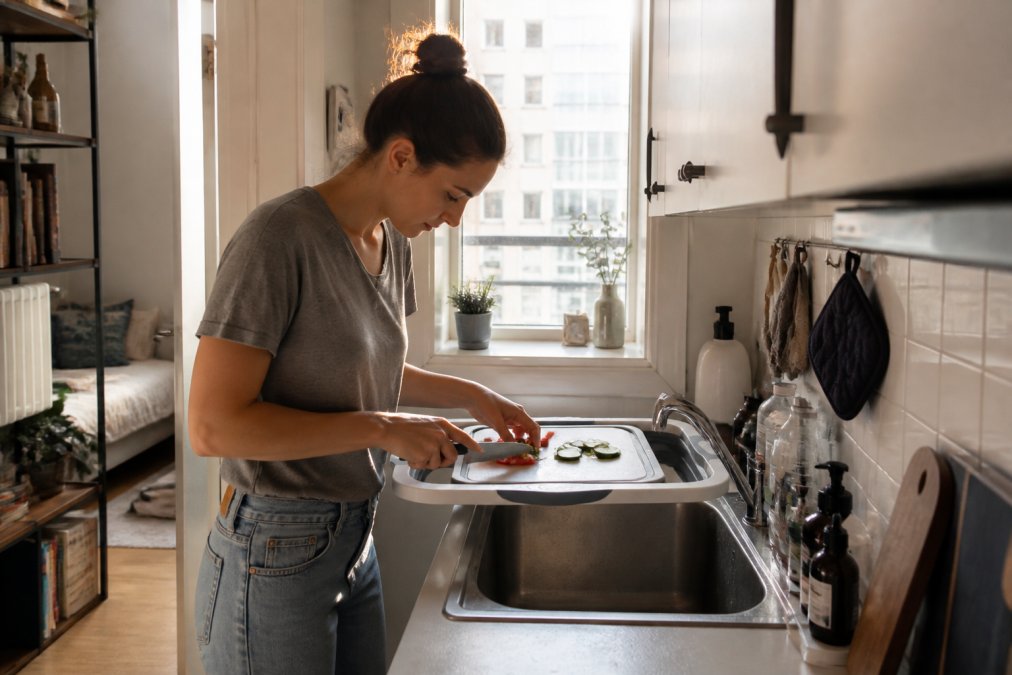
Foldable Kitchen Chopping Board ($22.99). It's a cutting board, drain basket, dish tub, and storage bin. Slice vegetables, twist the built-in drain plug to rinse them, then carry the whole thing to the stove. One object, four jobs, folding flat afterward.

9-in-1 Drain Basket ($29.99). This handles prep and cleanup in a single pass: cut vegetables in the rotating basket, then rinse them through the drainage grid without moving anything. Multiple knife heads cover slicing, dicing, and shredding, and the non-slip handle lets you work one-handed.
Digital LCD Measuring Cup Scale ($20.99). A scale and measuring cup in one detachable unit. It converts flour, sugar, milk, water, and oil from weight to volume automatically and reads ingredient temperature in real time, eliminating a whole shelf of measuring cups.
Collapsible and Nesting Tools
Collapsible and nesting tools make small kitchens genuinely workable. They store flat, stack inside each other, or fold down to a fraction of their working size. The trade-off is usually durability, so check materials before buying.
The Portable Foldable Silicone Electric Kettle ($33.99) is the standout. It holds 0.6 liters, boils in under two minutes on an 800-watt stainless steel heating plate, and collapses to fit in a lunch bag. It has automatic power cut-off and a one-year warranty, reclaiming counter space from a kettle you use twice a day.
For food storage, the Mini Heat Bag Sealer ($14.99) and Mini Automatic Vacuum Sealer Pump ($23.99) both live in a drawer and take up almost nothing. The sealer reseals snack bags with a slide; the vacuum pump shrinks bulky packaging so it stacks. In a small freezer, that compression is the difference between fitting a week of food and three days.
How to Organize Small Kitchen Cabinets for Maximum Efficiency
Learning how to organize small kitchen cabinets comes down to three moves: zone by task, stack vertically, and keep the most-used items at waist height. The detail is where a compact kitchen is won or lost.
Zones first. Group items by where you use them, not by what they are: coffee, mugs, and filters above the counter where you brew; cutting boards, knives, and mixing bowls near the prep area. Most kitchens are organized by category, which forces you to walk the length of the kitchen to make one meal, and in a compact kitchen, that walk is the whole room.
Then apply these rules:
- Put daily items between hip and shoulder height
- Reserve top shelves for seasonal or occasional gear
- Use risers so stacked plates and bowls are reachable in one motion
- Line up nesting items by size so they pull out as a set
- Leave one empty shelf for overflow, not zero
That last item matters more than it looks. A cabinet with no slack becomes a cabinet you can't maintain.
The Reach Zone Is the Real Constraint
Most small-kitchen cabinet advice ignores the physical reality of a cramped galley: you are not just short on cubic feet, you are short on comfortable reach. A base cabinet 24 inches deep means anything pushed past the front 12 inches requires you to bend, twist, or pull the whole stack forward, dozens of awkward reaches over a week of cooking.
Treat the front half of every deep cabinet as your working zone and the back half as long-term storage. Pull-out shelves and sliding baskets convert dead rear space into usable space because the whole tray comes to you. If you can't install pull-outs, a lazy Susan in a corner base cabinet does the same job for a fraction of the cost.
Measure Before You Buy Anything
Before adding a single organizer, measure three things: the interior width of your deepest cabinet, the height between shelves, and the clearance under your upper cabinets. A bin half an inch too wide won't slide, and a stack of identical bins often hides one that won't clear the shelf above it once a lid is on.
A practical rule: leave at least two inches of vertical clearance above any stacked item so you can grab it without lifting the shelf above. If your shelves are adjustable, moving one peg up is free and often recovers more usable space than any product you can buy.
Keep the Counter Clear by Pushing Storage Up
The goal of cabinet organization in a small kitchen is not a tidy cabinet, it is an empty counter. Every item you move from the countertop into a cabinet, onto a wall rail, or over the sink is square footage back for actual prep. That is why vertical storage and cabinet zoning are the same project: organize the cabinet so the thing you use most is easiest to pull out and put back, and it stops migrating to the counter.
Ergonomics and Maintenance for Compact Kitchen Gear
Ergonomics and maintenance are the two topics most small-kitchen guides skip, and they're the two that determine whether your setup still works in two years.
Ergonomics first. In a compact kitchen you repeat the same reach dozens of times a day, so small inefficiencies compound. Keep your primary prep surface clear and at a comfortable height; if your counter is low, a thick cutting board raises the work zone without a renovation. Choose tools with handles that fit your grip: the Stainless Steel Garlic Press ($14.99) uses an arc-shaped handle designed so people with smaller hands or weaker grips can squeeze without strain.
Maintenance is simpler than people expect:
- Rinse stainless steel and dry it immediately to prevent water spots.
- Hand-wash the Digital LCD Measuring Cup Scale; it isn't dishwasher safe.
- Wipe silicone folds with warm soapy water and let them air dry fully before folding.
- Descale the foldable kettle periodically if your water is hard.
- Keep the heat sealer's plate clean; residue burns and weakens the seal.
What to Skip and How to Declutter Your Kitchen
Decluttering a small kitchen is a subtraction exercise, and it's the highest-return work you can do. Every item you remove makes the remaining ones easier to reach. But in a compact kitchen, it is also about safety and airflow, the part most guides leave out.
Skip these:
- Single-function gadgets that duplicate something you own
- Oversized appliances that live on the counter and get used monthly
- Matching sets of anything, since you never use all of it
- Open shelving you can't keep tidy, which just displays clutter
The test I use: if you haven't touched it in a year and it isn't seasonal, it goes. Be honest about the bread maker. You know the one.
Decluttering Is Also a Safety Move
In a small kitchen, clutter is not just inconvenient, it is a fire and electrical risk. Compact kitchens often have fewer outlets and less ventilation, so a counter crowded with appliances forces you to daisy-chain power strips and run high-wattage devices like kettles, toasters, and microwaves on the same circuit, a common cause of tripped breakers and, in older wiring, overheating.
A practical approach: count how many heat-producing appliances you keep on the counter, and try to keep no more than two plugged in at once. Store the rest. Give any appliance that vents heat, such as a toaster or air fryer, at least a few inches of clearance on all sides and never tuck it under an upper cabinet while it runs. The U.S. Consumer Product Safety Commission's guidance on kitchen fire safety is worth a look before you rearrange, because placement matters as much as what you keep.
The Maintenance Cost of What You Keep
Every gadget you keep carries a hidden maintenance bill, higher in a small kitchen because tight storage traps moisture and crumbs. Before an item earns a permanent spot, ask two questions: can I clean it easily, and can I dry it fully before it goes back in the cabinet?
Items that fail that test quietly turn into clutter. A collapsible item that can't dry flat, a sealed container that traps odor, a rack that rusts in the sink drain all end up shoved to the back of a cabinet within a year, the real reason to skip them, not just the space they take.
Replace, Don't Just Remove
Once you've cleared the space, replace what's left with tools that pass the footprint test. The U.S. Environmental Protection Agency's guidance on reducing household waste makes a useful point here: buying fewer, better items and storing food properly reduces waste on both ends.
If you're furnishing a small kitchen from scratch, start with the five tools in the comparison table above and add nothing until a specific task forces you to. That approach beats buying a full set you'll half-use, and it keeps your outlets, your counters, and your airflow clear.
Frequently Asked Questions
What are the most useful gadgets for a tiny kitchen?
The most useful gadgets for a tiny kitchen are those that perform multiple tasks and store compactly. A foldable chopping board that doubles as a colander, a retractable sink rack that rolls up for storage, and a 9-in-1 drain basket that slices and washes vegetables all earn their space. Look for tools that replace two or three single-purpose items, and choose collapsible or stackable designs so they fit in drawers or cabinets without crowding your cooking surface.
How do you organize a kitchen with no counter space?
Start by moving prep work over the sink. A retractable stainless steel sink rack and a foldable chopping board let you chop, rinse, and drain without using the countertop. Mount a triangular sink organizer with suction cups to hold sponges and produce in the sink corner. Use vertical storage on walls or the inside of cabinet doors for utensils and lids. The goal is to keep the few inches of counter you have clear for actual cooking.
What kitchen tools are actually worth the space?
Tools that replace several others are worth the space. A 9-in-1 drain basket handles slicing, peeling, and washing in one unit. A digital measuring cup scale combines a scale, measuring cup, and thermometer. A stainless steel garlic press minces garlic, ginger, and nuts without a cutting board. Skip single-use gadgets like avocado slicers or egg separators unless you use them daily. If a tool only does one thing and takes up drawer space, it is probably not worth keeping.
What are the best multi-purpose kitchen gadgets?
The best multi-purpose kitchen gadgets combine prep, storage, or cooking functions. A foldable chopping board works as a cutting surface, drain basket, and storage bin. A 2-tier egg cooker steams eggs and custard in one compact appliance. A portable foldable silicone kettle boils water and collapses to fit in a bag. Choose gadgets that replace at least two single-purpose items and fold, nest, or stack when not in use.
How can I make my small kitchen more functional?
Focus on workflow and storage. Keep prep tools like a foldable chopping board and garlic press within arm's reach. Use a retractable sink rack to dry dishes over the sink instead of on the counter. Store dry goods with a mini heat bag sealer to keep bags flat and stackable. Group items by task, not by type, so you grab everything you need in one motion. Clear the counter of anything you do not use daily, and mount small organizers on walls or inside cabinet doors.